Skip to content

Every published route, priced by every operator

Helicopter routes and prices

Every route, priced by every CAAN-certified operator that flies it. Or name two landing sites and they will quote that instead.

Name two landing sites and the desk prices the leg with every licensed operator.

Whether you need the aircraft for the return
The leg you want flown
From
To

10 of 10 routes

Popular helicopter routes

Side by side

All 10 routes, priced

The complete list as a table, because a price is only useful next to another price. One shared seat and the whole aircraft, in the two columns operators quote them in.

Helicopter routes in Nepal with the starting price of one shared seat and of the whole helicopter, the flight time, and how many certified operators quote on each.
Everest Base Camp Helicopter TourHighest point 5,545 m · 40 min on the groundShared seatfrom US$499Whole helicopterfrom US$3,800Flight time4hOperators quoting5
Annapurna Base Camp Helicopter TourHighest point 4,130 m · 25 min on the groundShared seatfrom US$399Whole helicopterfrom US$1,850Flight time2hOperators quoting3
Muktinath Darshan HelicopterHighest point 3,710 m · 60 min on the groundShared seatfrom US$350Whole helicopterfrom US$1,700Flight time2h 30mOperators quoting3
Langtang Valley Helicopter TourHighest point 3,870 m · 40 min on the groundShared seatfrom US$575Whole helicopterfrom US$2,600Flight time2h 30mOperators quoting2
Gosaikunda Lake Helicopter TourHighest point 4,380 m · 30 min on the groundShared seatfrom US$499Whole helicopterfrom US$2,300Flight time2hOperators quoting2
Upper Mustang & Lo Manthang TourHighest point 3,810 m · 90 min on the groundShared seatNot sold as a shared seatWhole helicopterfrom US$3,200Flight time4hOperators quoting2
Pathibhara Temple HelicopterHighest point 3,793 m · 45 min on the groundShared seatfrom US$425Whole helicopterfrom US$1,600Flight time1h 30mOperators quoting2
Everest Base Camp Landing TourHighest point 5,364 m · 45 min on the groundShared seatfrom US$625Whole helicopterfrom US$4,600Flight time4h 20mOperators quoting3
Lukla – Kathmandu CharterHighest point 3,658 mShared seatfrom US$599Whole helicopterfrom US$2,600Flight time55mOperators quoting4
Everest Region Medical EvacuationHighest point 5,486 m · 15 min on the groundShared seatNot sold as a shared seatWhole helicopterfrom US$5,500Flight time1h 10mOperators quoting3

Starting prices from operators currently quoting on each route. The price you are offered depends on your date, your group weight and how many aircraft are free that morning — which is what the request actually asks them. Nothing is charged until you accept a quote.

Five kinds of flight

What each of these categories means

They are not marketing labels. Each one flies differently, is priced differently, and is booked differently — and the difference between a scenic tour and a pilgrimage flight is an hour on the ground, not the view.

Scenic toursA published morning: out, land, look, back.
A fixed profile the operator flies repeatedly — Everest, Annapurna, Langtang — with a set viewpoint landing and a set duration. Sold by the seat or by the aircraft. These leave at first light and are normally back before lunch.
PilgrimageTemple flights with time on the ground to worship.
Muktinath, Pathibhara, Gosaikunda. Structurally the same flight as a scenic tour with one difference that matters: the ground time is 45 to 90 minutes rather than 10, because you are there to complete a darshan rather than to photograph a ridge. Priced accordingly.
Point to pointA transfer between two places, no sightseeing.
Lukla to Kathmandu, Kathmandu to Bhadrapur, or any two landing sites in Nepal. You are buying the sector, not a view. These run year-round, go at short notice, and are the fastest way out of the mountains when a fixed-wing flight is grounded.
ExpeditionRestricted areas and high-altitude support.
Upper Mustang, Dolpo, base camp drop-offs and load carrying for climbing teams. Almost always whole-aircraft, because restricted-area permits are issued per helicopter rather than per passenger, and they need several days' notice.
MedevacEmergency evacuation, dispatched by phone.
Altitude sickness, injury and illness above the road head. Operators keep crews on call and can lift a casualty on a longline where there is nowhere to land. Do not use a booking form for one of these — call, because Nepali rescue is coordinated by voice.

Before you pick a row

Three things the price column does not tell you

Every figure on this page is a starting price for a specific route. What decides which route — and which price — is actually yours comes down to these.

Seat or aircraft

A seat wins below four people, the whole helicopter wins above it

A five-seat Airbus H125 on the Everest tour costs roughly eight times a single shared seat, so a group of four or five pays less each by taking the aircraft — and gets to choose the departure time, which a shared flight never allows.

  • Below four people, sharing wins on price and loses on flexibility.
  • A shared flight needs a set number of seats sold before it can go.
  • If it does not fill, the operator offers another date or refunds you in full.
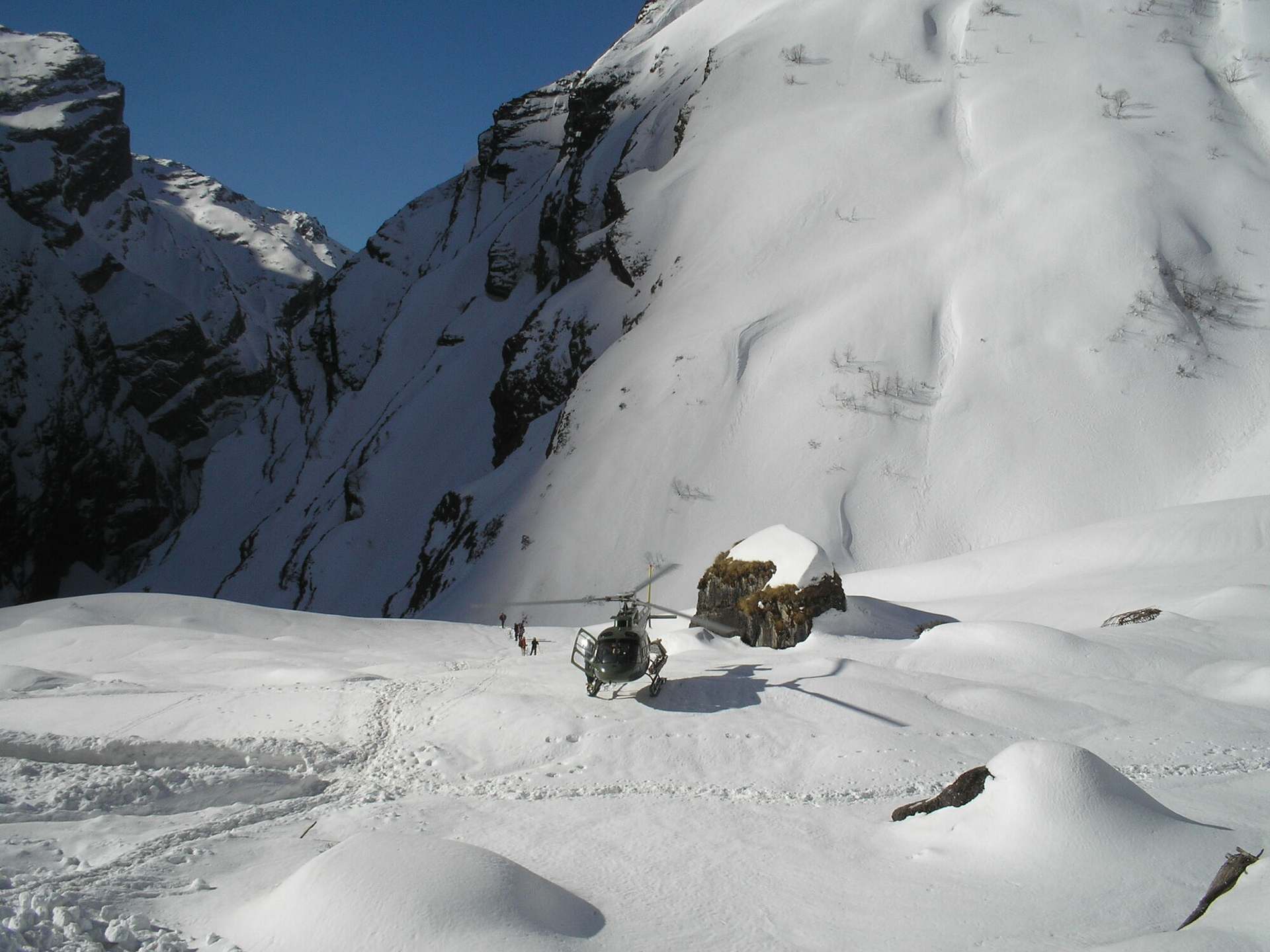
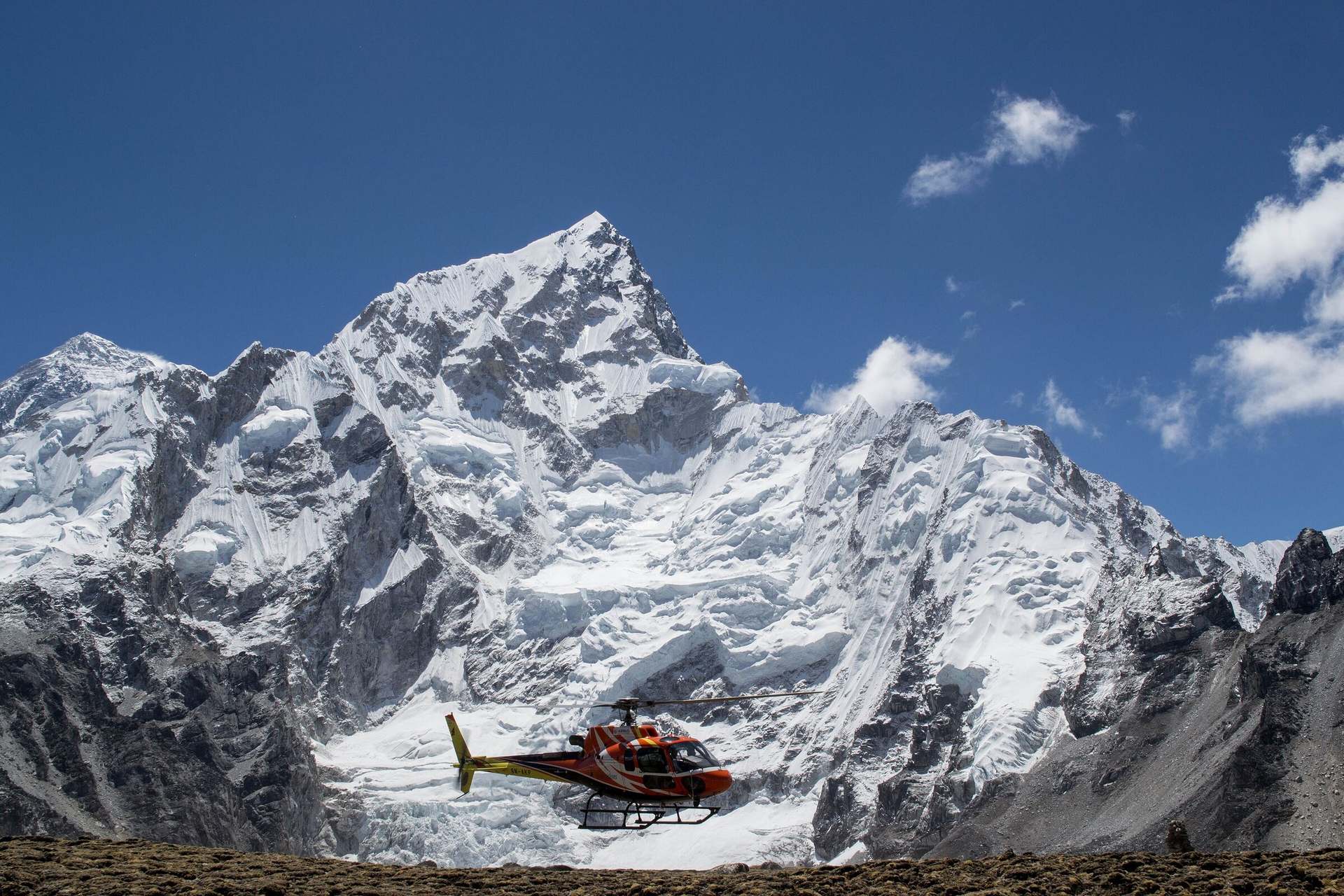
A single-engine helicopter lifting off a gravel landing site at Everest Base Camp, the Nuptse ice wall behind it.
© Daniel Oberhaus / Wikimedia Commons · CC BY-SA 4.0
Departure time

Every route on this page leaves at first light, and that is not a preference

Himalayan valleys build cloud and wind from mid-morning, every day of the year. A scenic flight offered for the afternoon is a flight that is likely to be cancelled.

  • Most departures are between 06:00 and 09:00.
  • October and November are the clearest weeks; June to September is the monsoon and cancellations are common.
  • Keep a spare day in your itinerary if you are flying outside the two peak windows.
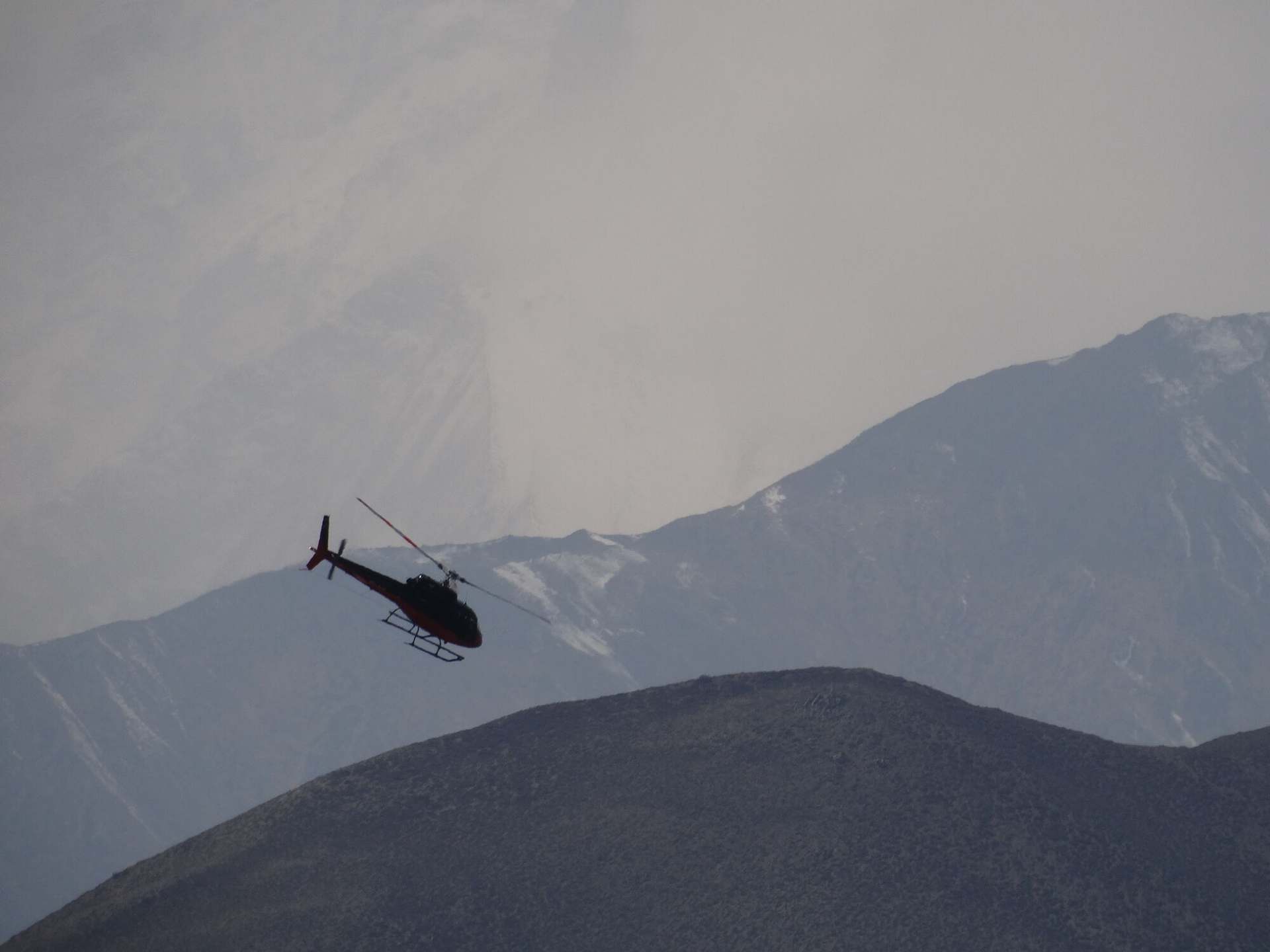
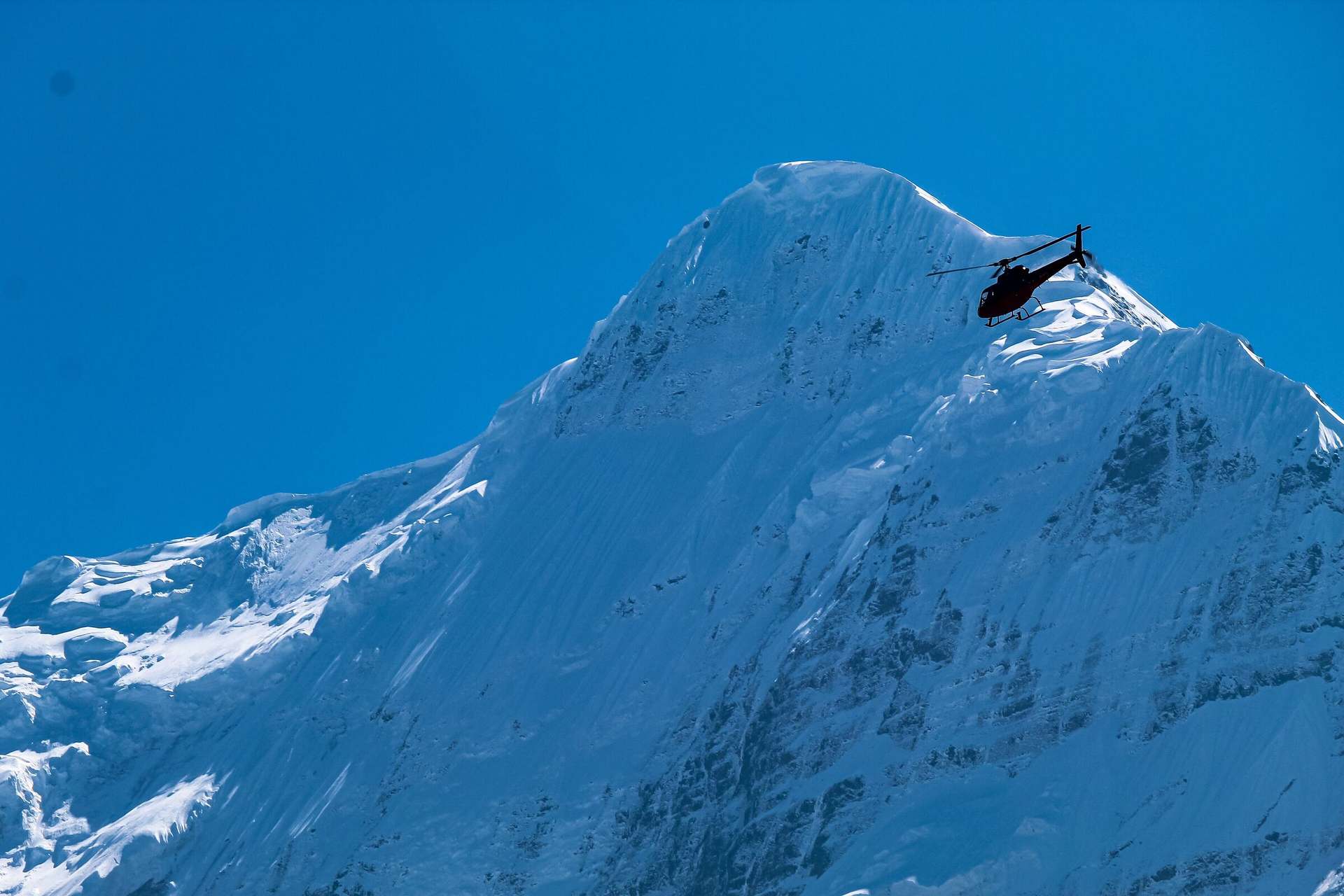
A helicopter in silhouette crossing the bare ridges above Muktinath in Mustang.
© Anuja Sharma / Wikimedia Commons · CC BY-SA 4.0
Weight and altitude

A helicopter carries less the higher it climbs

The five-seat figure holds at low altitude. Above about 5,000 m the same aircraft can only lift two or three people at a time, so a full group is shuttled up from an intermediate point such as Pheriche — the flight is not shorter, it is flown twice.

  • Operators generally set a limit of about 75 kg per passenger including your day bag.
  • You will be weighed at check-in, and the total decides whether the aircraft can climb.
  • Tell us your group's real weights when you request, so the quote is one the operator can honour.
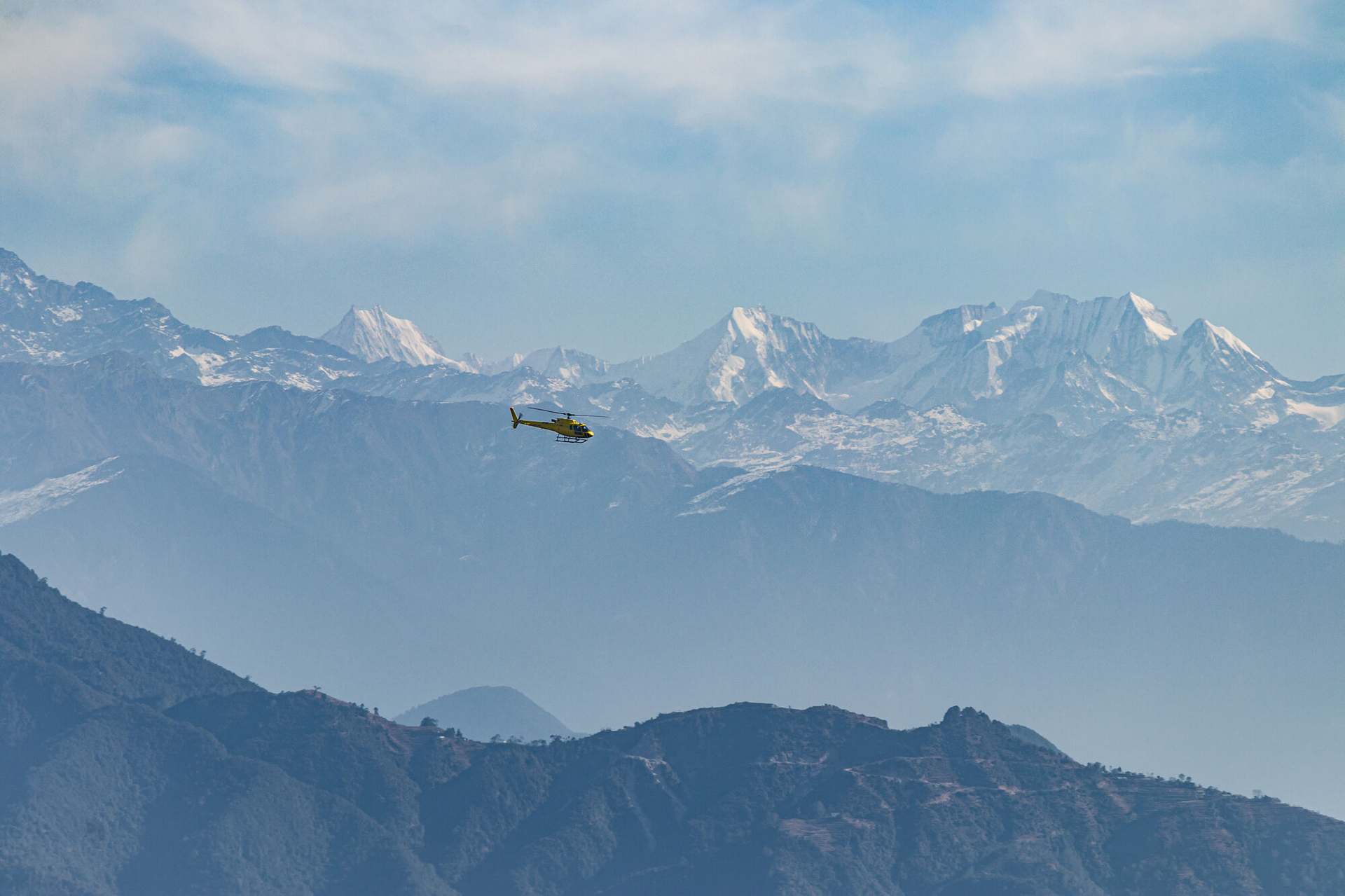
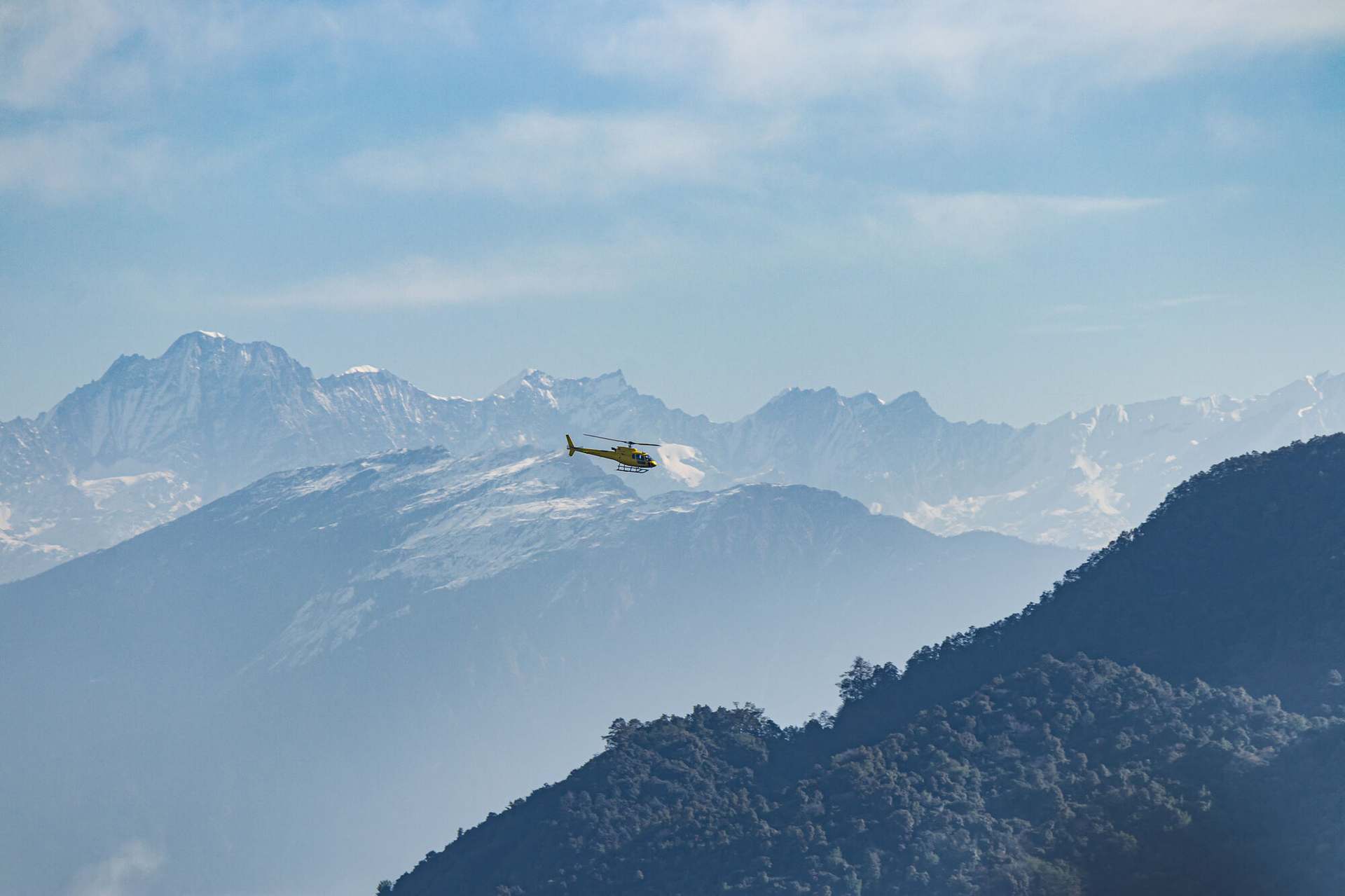
A helicopter crossing the Langtang range on a clear winter morning, ridges layered in haze below.
© Shadow Ayush / Wikimedia Commons · CC BY-SA 4.0

Not sure whether your group clears the limit? Tell us your group’s real weights when you enquire, and each operator prices an aircraft that can actually lift them at that altitude.

FAQs

Choosing between them

What is the cheapest helicopter flight in Nepal?

Shared seats on the shorter pilgrimage and valley routes are the cheapest way into a helicopter in Nepal, starting around USD 350 per person for Muktinath and around USD 400 for Annapurna Base Camp. Everest routes cost more because they are longer, climb higher and need a fuel stop. The cheapest whole-aircraft flights are the short transfers rather than the tours. An empty leg — a helicopter that has to fly home anyway — is cheaper than any of them, but you have to take the date it is going.

Is it cheaper to book a seat or the whole helicopter?

A seat is cheaper for one or two people; the whole helicopter is cheaper per head from about four. A five-seat Airbus H125 on the Everest tour costs roughly eight times a single shared seat, so a group of four or five pays less each by taking the aircraft — and gets to choose the departure time, which a shared flight never lets you do. Below four people, sharing wins on price and loses on flexibility.

Can I fly between any two places in Nepal by helicopter?

Broadly yes, and the routes listed here are only the published ones. Any two landing sites in the country can be chartered as a point-to-point sector, including sites with no published price, and operators will quote a leg that appears nowhere on this page. Restricted areas — Upper Mustang, Dolpo, the northern border districts — need a permit issued per aircraft and several days' notice. Weather and daylight are the real constraints, not the map.

How many people fit in a helicopter in Nepal?

Five passengers in the Airbus AS350 and H125, which is what almost all mountain work is flown on, and nine in the twin-engine Bell 412 used for cargo and rescue. The five-seat figure holds at low altitude. Above about 5,000 m the same aircraft can only carry two or three at a time, so a full group is shuttled up from an intermediate point such as Pheriche — the flight is not shorter, it is flown twice.

How far in advance do helicopter routes get booked out?

In October, November, March and April, shared seats on the Everest and Annapurna tours fill two to four weeks ahead and whole aircraft on a fixed date go earlier than that. Outside those months a day or two is usually enough. Point-to-point transfers and all rescue flights are arranged the same day, year-round. Asking costs nothing and the prices come back within four hours, so there is no reason to hold a date by guessing.

Do helicopter prices in Nepal change with the season?

Yes, though less than hotel prices do. Operators quote higher in the two peak windows because every aircraft is committed, and lower in the monsoon when they are not. Aviation fuel is the larger driver: it is imported, priced in dollars, and a fuel move passes into charter rates within weeks. Because prices here come from the operators rather than from us, the figures on this page move when theirs do.

Seat or whole helicopter depends on how many of you there are — work out the cost per person for your party and see which way is cheaper, and at what group size that flips.

Ready when you are

Tell us your route, and the desk asks every operator that flies it

Four hours to a set of prices you can compare side by side. Nothing to pay until you accept one.

Call the deskWhatsAppRescue and medevac — call +977 98 6104 4994