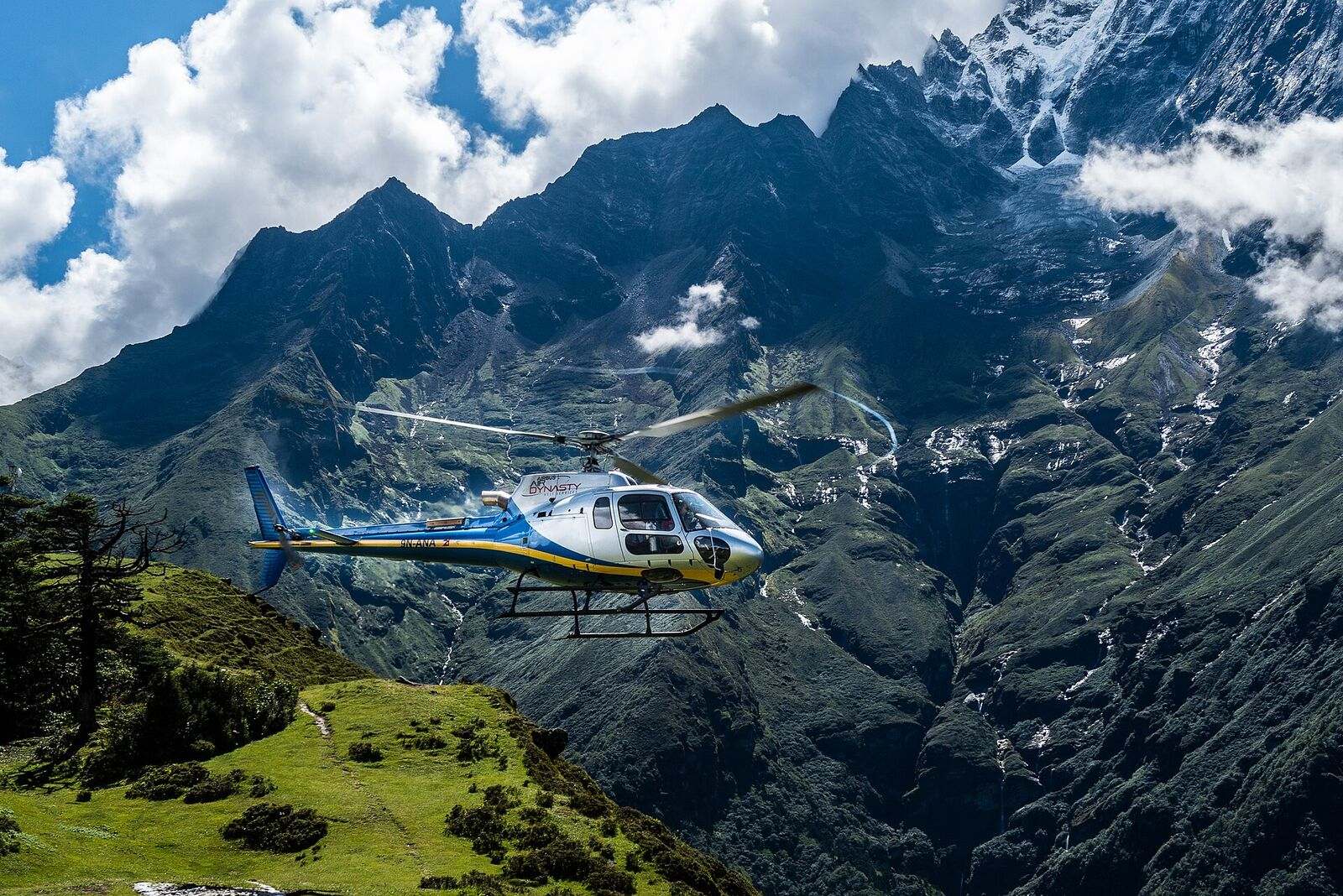
 © Mondo79 / Wikimedia Commons · CC BY 2.0
What a helicopter rescue on Everest costs
Reviewed · 6 min read
How much does a helicopter rescue from Everest cost, and who pays?
A helicopter evacuation from the Everest region costs roughly US$3,000 to US$8,000, depending on how high the pickup is, how long the aircraft flies and whether a longline and a specialist crew are needed. A straightforward lift from Everest Base Camp or a village on the trekking route sits at the lower end; an extraction from high on the mountain sits well above it. The operator flies on the medical need and bills afterwards — you are never asked to arrange payment before an aircraft launches. Whether you or your insurer ends up paying depends on your policy: many standard travel policies exclude trekking above 4,000 m, which is below Everest Base Camp, or cap helicopter evacuation far below its real cost.
- Typical evacuation cost
- US$3,000–8,000
- From Everest Base Camp
- US$4,000–6,000
- Highest longline extractions
- About 7,800 m
- Highest routine rescue landing
- Camp 2 · about 6,400 m
- Paid before the flight
- Nothing
- Common insurance exclusion
- Trekking above 4,000 m
If this is happening now
This page is for planning. If somebody needs an aircraft today, call the 24-hour rescue line on the rescue page — it is answered at any hour and the request goes straight to operators holding on-call crews. Do not spend that call working out who pays. The flight comes first and the paperwork follows it, always.
What drives the number
Helicopter time is the bulk of it. A high-altitude single-engine machine costs several thousand dollars an hour to operate in the Himalaya, and an evacuation is rarely one flight: the aircraft may reposition, refuel at Lukla, fly the pickup, and then continue to a hospital in Kathmandu.
Altitude multiplies everything. Above roughly 6,000 m the aircraft can no longer land with a useful load, so a longline is rigged and a specialist crew flown in, and the flight becomes a two- or three-aircraft operation. That is the difference between a $4,000 lift from base camp and a five-figure extraction from the upper mountain.
| Pickup | Altitude | Indicative cost |
|---|---|---|
| Namche Bazaar / lower trail | 3,440 m | $2,500–4,000 |
| Gorak Shep / Everest Base Camp | 5,164–5,364 m | $4,000–6,000 |
| Camp 2 | 6,400 m | $8,000–15,000 |
| Upper mountain, longline | up to about 7,800 m | Quoted per operation |
The insurance clause that catches people every season
Read two numbers in your policy before you leave home: the altitude limit and the evacuation cap. A great many standard travel policies exclude trekking above 4,000 m — Everest Base Camp is at 5,364 m, so the entire second half of the classic trek is outside cover. Others include high-altitude trekking but cap helicopter evacuation at $1,000 or $2,000, which does not pay for one.
The policies that work name helicopter evacuation explicitly, state an altitude limit at or above 6,000 m, and carry an evacuation limit in the tens of thousands. They cost more, and they are the difference between a claim and a bill.
Carry the policy number and the assistance company's phone number written down somewhere that does not need a signal. A policy you cannot quote at 04:00 is a policy that slows the flight down.
How the billing actually works
The aircraft launches on the medical picture. Nobody at a reputable operator will delay a genuine evacuation to verify a credit card, and if anyone does, that tells you what you need to know about them.
Afterwards, the operator bills either your insurer or you. If your insurer pays, you may never see an invoice. If your policy excludes the flight, the invoice is yours, and Nepali operators do pursue them.
Because that model was abused in the past — a 2018 government investigation into inflated and fabricated evacuation claims changed the industry — insurers now ask for documentation: a medical report, the flight record, and evidence the evacuation was necessary rather than convenient. Keep everything you are given at the hospital.
Descending is cheaper and safer than any of this
Altitude sickness resolves by going down. Several hundred metres of descent frequently turns a case that needed an aircraft into a case that no longer does, and it turns an impossible retrieval into a routine one.
Do not wait for the weather to make the choice for you. Helicopters in the Khumbu fly in the morning; a decision deferred to the afternoon is often a decision deferred to tomorrow.
FAQs
How much does a helicopter rescue from Everest Base Camp cost?
An evacuation from Everest Base Camp or Gorak Shep typically costs between US$4,000 and US$6,000. The figure covers the aircraft's flying time, which usually includes repositioning and a refuelling stop at Lukla as well as the pickup itself and the run to a hospital in Kathmandu.
Who pays for a helicopter rescue in Nepal?
The operator flies first and bills afterwards, either to your travel insurer or to you. Nothing is paid before the aircraft launches. If your policy excludes high-altitude trekking or caps evacuation cover, the bill lands on you, and Nepali operators do pursue unpaid ones.
Can a helicopter rescue someone from high on Mount Everest?
Up to a point. Helicopters land in rescues as high as Camp 2, around 6,400 m, and above that use a longline — a cable slung beneath the aircraft — with extractions carried out at around 7,800 m in exceptional cases. Above that, a casualty has to be brought down by other climbers before any aircraft can reach them.
Does travel insurance cover helicopter evacuation in Nepal?
Only if the policy says so explicitly. Many standard policies exclude trekking above 4,000 m, which rules out most of the Everest Base Camp route, or cap evacuation cover far below the US$3,000–8,000 an evacuation actually costs. Check the altitude limit and the evacuation cap as two separate numbers before you travel.
How do you call a helicopter rescue in the Everest region?
By telephone, not by email or a form. Your guide, your lodge or you calls an operator or an assistance company directly, gives the casualty's location, symptoms, approximate weight and a callback number, and a crew is tasked. Where there is data but no voice signal, a written request can be sent instead — but voice is faster whenever there is any signal at all.
Related reading: The insurance clause that voids your helicopter evacuation