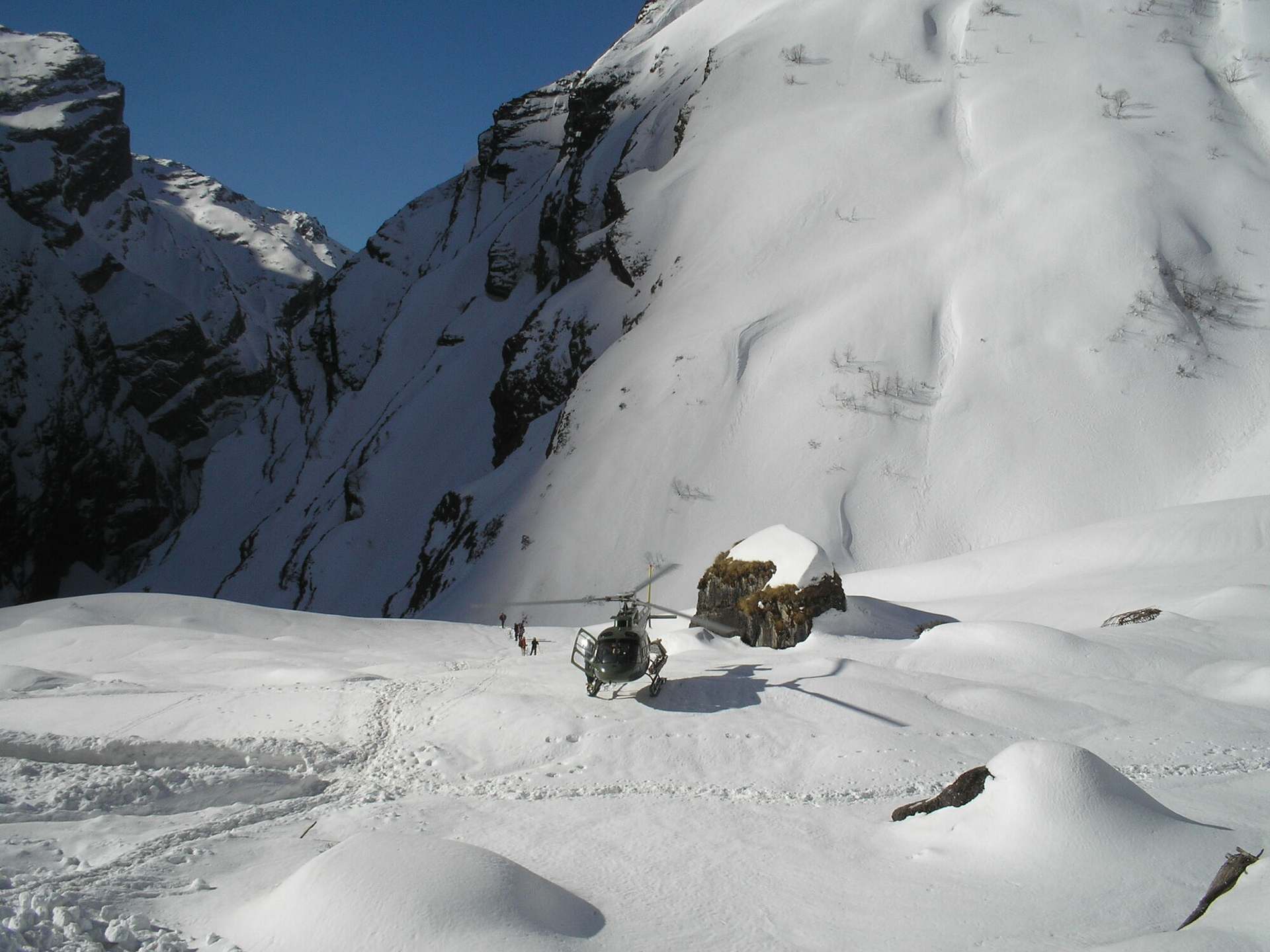
 © Sgroey / Wikimedia Commons · CC BY-SA 4.0
How cold is Mount Everest?
Reviewed · 7 min read
How cold is the top of Mount Everest?
The summit of Mount Everest averages about −36 °C (−33 °F) in January and about −19 °C (−2 °F) in July, its warmest month. The summit air is not known to rise above freezing at any point in the year, which is why the mountain is under snow and ice permanently. In winter the temperature can approach −60 °C (−76 °F), and sustained winds above 160 km/h (100 mph) push the felt temperature far lower still. Everest Base Camp, 3,485 m lower at 5,364 m (17,598 ft), is very much milder: roughly 0 °C to 5 °C on a clear spring day and −15 °C to −20 °C overnight.
- Summit elevation
- 8,848.86 m · 29,032 ft
- Summit average, January
- −36 °C · −33 °F
- Summit average, July
- −19 °C · −2 °F
- Lowest, in winter
- about −60 °C · −76 °F
- Base camp, 5,364 m
- 0 to 5 °C day · −20 °C night
- Above freezing at the summit
- Never recorded
The summit: two numbers worth remembering
January is the coldest month and July the warmest, and the gap between them is smaller than people expect. The peak averages around −36 °C (−33 °F) in midwinter and around −19 °C (−2 °F) in summer, at the height of the monsoon. Both are far below freezing, and that is the whole point: Everest has no warm season, only a less severe one.
The extremes matter more than the averages for anyone standing there. The lowest temperatures, on a bad winter night on the summit ridge, approach −60 °C (−76 °F). Exposed skin freezes in minutes at that, and that is before the wind is counted.
| Month | Summit · 8,849 m | Base camp · 5,364 m | Kathmandu · 1,400 m |
|---|---|---|---|
| January | −36 °C / −33 °F | −17 °C / 1 °F | 10 °C / 50 °F |
| April | −26 °C / −15 °F | −4 °C / 25 °F | 20 °C / 68 °F |
| July | −19 °C / −2 °F | 3 °C / 37 °F | 25 °C / 77 °F |
| October | −27 °C / −17 °F | −6 °C / 21 °F | 18 °C / 64 °F |
Why it is that cold: 6.5 °C for every kilometre up
Air cools as it rises and expands, at roughly 6.5 °C per 1,000 m. That single rule explains most of the mountain. Kathmandu sits at 1,400 m; the summit is 7,450 m higher; multiply and you have lost about 48 °C before anything else is considered. A pleasant 20 °C morning in the capital is −28 °C at the top of the mountain on the arithmetic alone.
The rest of the difference is radiation and wind. Thin air holds little heat, so the ground gives up its warmth to the sky the moment the sun is off it — which is why the temperature on a Himalayan slope can drop 20 °C in the hour after sunset, and why every helicopter flight into the Khumbu is a morning flight.
Wind is what actually hurts
From October to May the subtropical jet stream sits directly on the summit of Everest. Sustained winds over 160 km/h (100 mph) are ordinary in that period, and the plume of snow blowing off the summit ridge that appears in most photographs of the mountain is the jet stream made visible.
Wind chill turns a survivable air temperature into an unsurvivable one. At −30 °C with a 100 km/h wind, exposed flesh freezes in well under five minutes. This is also why the climbing season is so short: the jet stream lifts north as the monsoon arrives, the summit winds fall away for a few weeks in May, and that lull — not the temperature — is the window everyone is waiting for.
Base camp and the valley are a different mountain
Everest Base Camp is at 5,364 m (17,598 ft), almost three and a half kilometres below the summit, and its weather has very little to do with what is happening up there. A clear spring day at base camp is around 0 °C to 5 °C in the sun and genuinely pleasant out of the wind. The night that follows is −15 °C to −20 °C.
Lower still, the numbers become ordinary. Namche Bazaar at 3,440 m runs from −8 °C to 12 °C across the year, and Lukla at 2,845 m is milder again. Trekkers who have read the summit numbers frequently over-pack for the valley and under-pack for the two hours after sunset, which is the part that catches people.
For a helicopter passenger this is the practical span: you take off in Kathmandu at about 10 °C before dawn and step out at Kala Patthar, 5,545 m, into something between −10 °C and −15 °C with rotor downwash on top of it. That is a jacket, hat and gloves worn on the aircraft, not packed in a bag.
Is Mount Everest always snowy?
Yes. The peak sits permanently above the freezing level, so snow that falls there never melts — it is scoured off by wind or compacts into the ice cap. The mountain's rock only shows where the slope is too steep or too wind-blasted to hold snow at all.
What does change is how much. Post-monsoon in October the mountain carries its deepest cover; by late winter the jet stream has stripped the upper ridges bare enough that climbers describe them as blue ice rather than snow.
A note on today's temperature
Nobody measures the summit of Everest in real time in the way a city weather station is measured. Automatic weather stations have been installed high on the mountain since 2019 — the highest around 8,430 m on the Balcony — and they have transformed what is known about conditions up there, but a figure presented as "the temperature on Everest right now" is almost always a model output for a grid square, not a reading.
Treat any live summit number, including ours if we ever publish one, as an estimate with a wide error bar. The climatology on this page is the more useful thing to plan around: it is what conditions have actually been, month by month, over decades.
FAQs
What is the lowest temperature ever recorded on Mount Everest?
Winter temperatures near the summit of Mount Everest approach −60 °C (−76 °F), which is the lowest figure reliably associated with the mountain. There is no single official record low for the summit, because continuous instrumented measurement there only began in 2019 with the installation of automatic weather stations high on the south side of the mountain, the highest at around 8,430 m.
How cold is Everest Base Camp?
Everest Base Camp, at 5,364 m (17,598 ft), is around 0 °C to 5 °C on a clear spring day and falls to −15 °C to −20 °C overnight. In midwinter, night temperatures there drop below −25 °C. It is far milder than the summit, which is almost three and a half kilometres higher.
Does the temperature on Everest ever go above freezing?
Not at the summit. The top of Mount Everest is not known to have risen above 0 °C at any point in the year, which is why its snow and ice are permanent. Lower on the mountain it is a different story: base camp is regularly above freezing in daylight during spring and autumn.
How cold are the Himalayas generally?
Temperature in the Himalayas is governed almost entirely by elevation, falling about 6.5 °C for every 1,000 m of height gained. A valley town at 1,400 m can be 25 °C on the same afternoon that a 5,500 m pass a day's walk away is below freezing. That gradient, rather than the season, is what determines what you need to wear.
What is the best month to see Everest?
October and November give the clearest air of the year: the monsoon has washed the haze out and the winter winds have not yet built. March to May is the second window and the only season when base camp exists as a working settlement. Visibility, not temperature, is what makes those months better.
Is it cold inside a helicopter flying to Everest?
The cabin is heated and comfortable in flight. The cold arrives when the doors open at a landing site above 5,000 m, where the air is between −10 °C and −15 °C with rotor downwash on top of it. Wear your insulated jacket, hat and gloves on the aircraft rather than packing them.
Related reading: The best time of year for an Everest Base Camp helicopter tour