Helicopter Charter and Transfers in Nepal
Go Heli Nepal7 min read
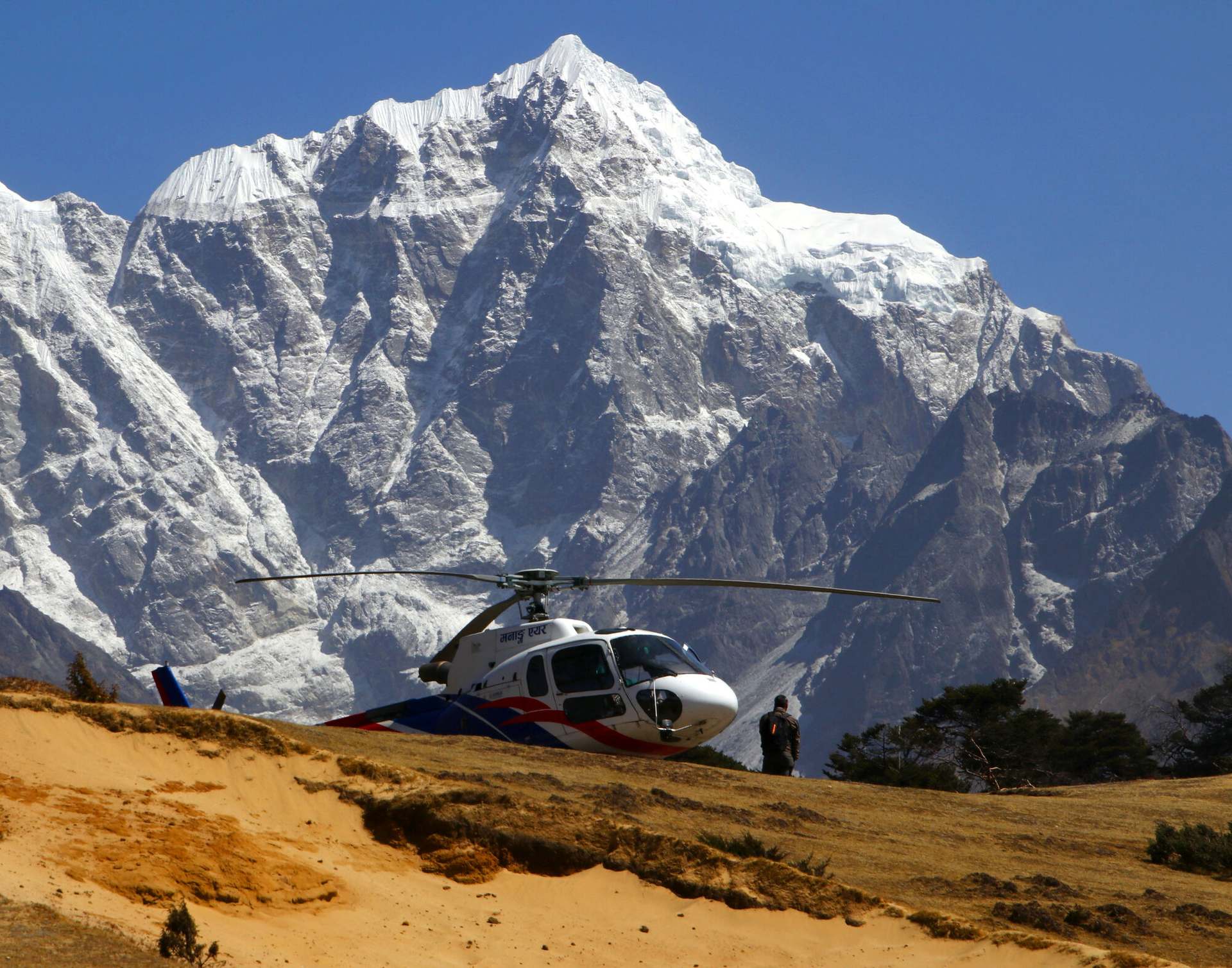
Photograph: © Shadow Ayush / Wikimedia Commons · CC BY-SA 4.0
A charter is the whole aircraft, billed by the hour of block time. What a Nepali quote is built from, and who pays when the weather holds it.
A helicopter charter in Nepal is the hire of a whole aircraft between two points you choose, billed by the hour of block time rather than by the seat. A transfer is that same hire flown as a journey rather than a sightseeing circuit. Both run under an operator's Air Operator Certificate from the Civil Aviation Authority of Nepal. The price is built from four things: block time, positioning, a daily minimum, and the fees that sit outside the rate.
Most of it starts in Kathmandu, at Tribhuvan International Airport, about 1,400 m above sea level and the base for most of the country's helicopter fleet. From there the subject divides four ways: a seat on a packaged sightseeing flight, private charter of the whole aircraft, a point-to-point transfer, and the operator whose certificate the flight runs under. This page is the whole-aircraft side of that — what you are hiring, how it is billed, and what the number is made of. A packaged seat is a different purchase on different economics and is covered elsewhere.
What counts as a charter, and what counts as a transfer?
A charter is the aircraft, not the route. You name two landing sites and the operator prices the machine, the crew and the flying between them. What happens in the middle is yours to set.
A transfer is a charter with a destination instead of a circuit. Kathmandu to Lukla, Pokhara to Jomsom, a trek exit from Namche: the aircraft takes you somewhere and leaves you there. The billing is identical. The difference is that nobody rides the way home, and that empty return is in your price.
A tour seat is neither. It is one place on a flight the operator was going to run anyway, at a published price and on a published profile. It is the cheaper way to see something and the wrong way to get somewhere.
How is a helicopter charter billed in Nepal, by the hour or by the sector?
Both shapes are in use, and which one you were quoted matters more than the rate inside it.
The hourly shape is the common one. Charter is billed by the hour of block time, which this site's charter page defines as engine start to engine stop — taxi, run-up, shutdown and any time the aircraft waits with its rotors turning. Block time is therefore always longer than flight time. A 55-minute sector is usually quoted at around 1.2 hours of block.
That gives a rule worth carrying: take the flying time a route page advertises, add about a fifth, and that is the number the hourly rate is multiplied by. Published route times are flight times, not billed ones. It is the same principle operators state when they explain that the meter runs on engine time rather than on kilometres covered, and it is the single most common reason a quote arrives higher than a reader's own arithmetic.
Then check the result against the minimum. Most Nepali operators set a daily minimum of roughly one to two hours of block time, because an aircraft committed to your morning cannot be sold to anybody else. Below that threshold a ten-minute hop and a forty-minute one cost the same. On short sectors it is the minimum rather than the rate that sets the bill.
The other shape is a fixed price for a named sector. Nepali operators' published 2026 rate guides describe most charters this way — a price for the route — with hourly pricing kept for short local work and sightseeing. The total is agreed before the day and does not move when the day does.
| Component | What it means | Can you influence it? |
|---|---|---|
| Block time | Engine start to engine stop, not time in the air | Yes — a shorter ground stop |
| Positioning | The empty legs flown to reach you and get home | Yes — pick an operator already near you |
| Daily minimum | The least an operator bills for committing an aircraft | No, but a longer leg absorbs it |
| Landing and permits | Aerodrome fees, park entry, restricted-area permits | No — but ask what the quote already covers |
The four components a Nepali charter quote is assembled from. Rates move with fuel and season and are not reproduced here; ask for the total rather than the hourly figure.
Why does a Kathmandu to Lukla transfer depend on where the aircraft starts?
Because you pay for the sectors the aircraft flies, not the sectors you ride.
A one-way transfer to Lukla is one leg for you and at least two for the machine: the leg you are on, and the empty run back to base. If the aircraft is not in Kathmandu when you book, there is an empty leg in front of yours as well. That is three or four sectors flown against one ridden, and it is the largest single reason two certified operators quote differently for an identical journey.
So count the sectors before you compare the prices. An operator with an aircraft already going to Lukla that morning is pricing one extra landing. An operator whose aircraft is sitting in Pokhara is pricing a round trip to Kathmandu before your flight has begun.
The same arithmetic explains where a real saving lives. On a same-day return the aircraft is billed for both directions whatever you do, so leaving it waiting on the ground is cheaper than sending it home empty and bringing it back. Stay overnight and most of that saving goes, because the operator either flies the aircraft home or pays the crew to stay with it. Say which you intend when you ask for the price.
Timing matters at the Lukla end for a reason that is not about money. Tenzing–Hillary Airport sits at 2,845 m and its fixed-wing schedule collapses often enough that charter demand spikes exactly when spare aircraft are scarcest. A backlog is the worst moment to be discovering where the nearest helicopter is.
Who pays when the weather holds the aircraft on the ground?
It depends on the shape of the quote, and almost nothing published on this subject says so.
Under an hourly quote you are buying minutes, so the extra minutes are yours. Waiting with the rotors turning is block time and is billed as block time. Waiting with the engine shut down is not, but it still consumes the aircraft's day, which is the thing a daily minimum exists to price. Under a fixed price for a named sector the total is already agreed and a long day is the operator's cost.
That is an argument for asking which shape you are being offered rather than only what it costs. When the weather is marginal — the monsoon months, or a shoulder week with cloud in the valleys — a fixed sector price is usually worth paying for. In a settled October window an hourly quote is usually the cheaper of the two.
A hold is not a cancellation, and the two are priced in opposite directions. A flight the operator cancels for weather is not charged at all on this site: you take another date or a full refund. The decision to fly, delay or cancel belongs to the pilot in command and is final, and an intermediary willing to lean on an operator about that decision is telling you something about itself.
| Quote shape | What is fixed in advance | Who carries a weather hold |
|---|---|---|
| Per hour of block time | The hourly rate | You, from the first extra minute |
| Fixed price for the sector | The total | The operator |
What certificate does the flight run under, and who is the contract with?
An Air Operator Certificate issued by the Civil Aviation Authority of Nepal. It is what makes commercial carriage lawful, and it is a floor every certified operator meets equally rather than a quality grade that some meet better than others.
Nepal's National Aviation Safety Plan for 2023 to 2025, the country's filing with ICAO, records 21 air operator certificates issued in Nepal, five of them for international commercial air transport. The domestic helicopter operators sit inside the remainder.
The contract is with the operator rather than with the marketplace. Go Heli Nepal passes your request on, and it becomes a booking when an operator accepts it. The aircraft, the crew, the certificate and the passenger liability cover all belong to that operator, and their name is on the invoice. We verify that the certificate and the insurance are current before an operator can take work here, and a listing comes off the day either lapses. We do not own aircraft and we do not employ pilots.
This is worth knowing when a cheap quote and an expensive one arrive on the same morning. The permission to fly is identical. What differs is where the aircraft was.
What sits outside the quoted price?
Domestic airport and landing fees are usually inside it. National park entry, restricted-area permits and any overnight crew costs usually are not, and that is where two quotes most often differ in what they include rather than in what they charge.
Permits move a date rather than a total. Nepal's Department of Immigration issues the Restricted Area Permit required for Upper Mustang and Upper Dolpo, an individual cannot file it — a registered agency does — and the agencies that file them quote three to five working days. On a restricted-area flight the paperwork, not the aircraft, is usually the constraint.
Which makes the useful question a short list rather than a single number. What is the total, which sectors does it cover, is it hourly or fixed, and what is the minimum. Four answers settle almost everything that otherwise turns into a surprise on the day.
FAQs
What is the difference between a helicopter charter and a helicopter transfer in Nepal?
A helicopter charter in Nepal is the hire of a whole aircraft between two landing sites you name, with the crew and the flying included and the itinerary yours to set. A transfer is that same hire flown as a one-way journey rather than a circuit — Kathmandu to Lukla, or a trek exit from the Khumbu. The billing basis is identical. The difference is that an aircraft which leaves you somewhere still has to get home empty, and that return sector is inside your price.
What is block time on a helicopter charter?
Block time is the unit a helicopter charter is billed in, measured from engine start to engine stop rather than from take-off to landing. It includes taxi, run-up, shutdown and any period the aircraft waits with its rotors turning, so it is always longer than the flight time a route page advertises. Go Heli Nepal's charter page puts a 55-minute sector at around 1.2 hours of block, which is a usable multiplier when estimating from a published flight time.
Why is a short helicopter transfer in Nepal not much cheaper than a long one?
Because most Nepali operators set a daily minimum — commonly one to two hours of block time — for committing an aircraft and a crew to a day, and a short sector is billed at that minimum rather than at what it flew. A helicopter tied up for your morning cannot be sold to anybody else. Positioning compounds it: a ten-minute hop still needs the aircraft brought to you and taken home again afterwards.
Who pays if a helicopter charter in Nepal is delayed by weather?
It depends on the shape of the quote, which is worth settling before the day rather than on it. Under an hourly block-time quote the extra minutes are the customer's: waiting with the rotors turning is billed, and waiting with the engine shut down still consumes the daily minimum. Under a fixed price for a named sector the total is agreed in advance and a long day is the operator's cost. A flight the operator cancels outright for weather is not charged at all — the choice is another date or a full refund.
What certificate does a helicopter operator in Nepal need?
An Air Operator Certificate issued by the Civil Aviation Authority of Nepal, which is what makes commercial carriage lawful and is a floor every certified operator meets equally. Nepal's National Aviation Safety Plan for 2023 to 2025 records 21 air operator certificates issued in the country, five of them for international commercial air transport. The contract for a flight is with the operator holding that certificate rather than with the marketplace that passed the request on, and the aircraft, the crew and the passenger liability cover are theirs.
What is not included in a Nepal helicopter charter quote?
Domestic airport and landing fees are usually inside a Nepali charter quote, while national park entry, restricted-area permits and overnight crew costs usually are not. Permits are the item that moves a date rather than a total: Nepal's Department of Immigration issues the Restricted Area Permit needed for Upper Mustang and Upper Dolpo, an individual cannot file it, and the agencies that do quote three to five working days. Ask for the total rather than the rate, and ask which sectors it covers.
Ready to fly this route?
Compare every licensed operator that flies it, with seat and whole helicopter prices side by side.
See operators and pricesThe full answer, kept up to date: What does a helicopter cost in Nepal?