527 metres, uphill: reading Lukla's runway
Go Heli Nepal5 min readReviewed
Photograph: © hsvgerrit / Wikimedia Commons · CC BY 4.0
The airstrip everyone calls the world's most dangerous is built that way on purpose. What the 11.7% slope does, and why there is no second attempt.
Tenzing–Hillary Airport at Lukla has 527 metres of asphalt on an 11.7 per cent uphill gradient, a mountainside at the top end and a drop at the bottom. It is described in every listicle as the world's most dangerous airport, which is a lazy way of describing something that was designed carefully.
It is also the closest airport to Mount Everest, which is why it exists and why it is the busiest strip in the Khumbu — how you actually get from Kathmandu to Lukla is the guide that goes with this.
| Measure | Figure |
|---|---|
| Runway length | 527 m (1,729 ft) |
| Gradient | 11.7 per cent, uphill to the north |
| Elevation | 2,845 m (9,334 ft) |
| Direction flown | Land uphill, take off downhill |
| Go-around | Not available below a certain point on the approach |
| Walk on to Everest Base Camp | About eight days |
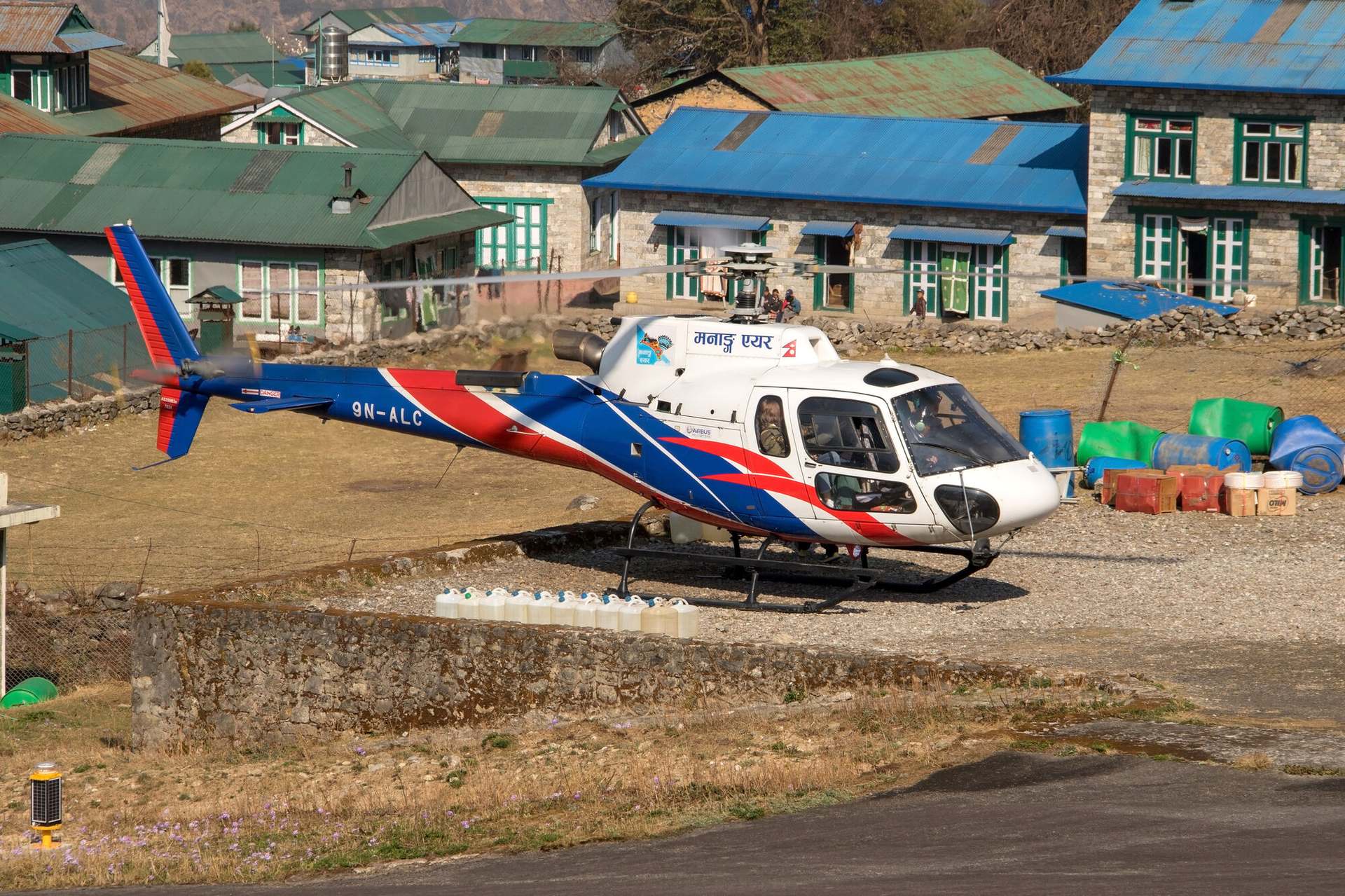
A helicopter covers the same ground in minutes, which is why a Lukla to Kathmandu charter is the standard fix when the fixed-wing queue collapses.
Why do aircraft land uphill at Lukla?
Aircraft land uphill. Gravity does most of the deceleration, which is exactly what you want on a strip a third the length of a normal one at an elevation of 2,845 m where the air gives wheel brakes and reverse thrust less to work with.
They take off downhill, for the same reason in reverse: the slope adds acceleration the thin air will not.
Why can a pilot not go around at Lukla?
On a conventional approach a pilot who is not happy can add power and try again. At Lukla the terrain removes that option below a certain point — the approach commits.
This is why the airport is flown only by specific aircraft types with crews who hold a Lukla qualification, and why the schedule is unforgiving about visibility. A pilot who cannot see the strip does not attempt it, and there is nothing marginal to attempt.
What happens to your trek when Lukla closes?
Lukla does not close for an hour, it closes for the day. The passengers from that day join the next day's queue, and two bad days in October can take three to clear.
Build a spare day into each end of a Khumbu itinerary. If you have an international flight to catch and the queue is long, a helicopter seat out is the standard fix — several times the fare, and routinely worth it.
FAQs
How long is the runway at Lukla airport?
Tenzing–Hillary Airport at Lukla has 527 metres of asphalt on an 11.7 per cent uphill gradient, at an elevation of 2,845 m. That is roughly a third the length of a conventional runway, with a mountainside at the top end and a drop at the bottom.
What is the altitude of Lukla airport in Nepal?
Lukla airport sits at 2,845 m above sea level in the Khumbu region of Nepal. At that elevation the thinner air gives wheel brakes and reverse thrust less to work with, which is one reason the runway is built on an uphill slope.
Why do aircraft land uphill at Lukla?
Aircraft land uphill at Lukla because the slope is the brake: gravity does most of the deceleration on a strip a third the normal length, where thin air weakens the usual braking. They take off downhill for the same reason in reverse, using the gradient to add the acceleration the thin air will not.
Can a pilot go around and try again at Lukla?
No. On a conventional approach a pilot who is unhappy can add power and try again, but the terrain at Lukla removes that option below a certain point — the approach commits. That is why the airport is flown only by specific aircraft types with crews holding a Lukla qualification, and why the schedule is unforgiving about visibility.
What happens if Lukla closes because of weather?
Lukla does not close for an hour, it closes for the day, and those passengers join the next day's queue — two bad days in October can take three to clear. Build a spare day into each end of a Khumbu itinerary; if you have an international flight to catch and the queue is long, a helicopter seat out is the standard fix.
Ready to fly this route?
Compare every licensed operator that flies it, with seat and whole helicopter prices side by side.
See operators and pricesThe full answer, kept up to date: Flying from Kathmandu to Lukla