Everest temperature month by month, from base camp to the summit
Go Heli Nepal6 min readReviewed
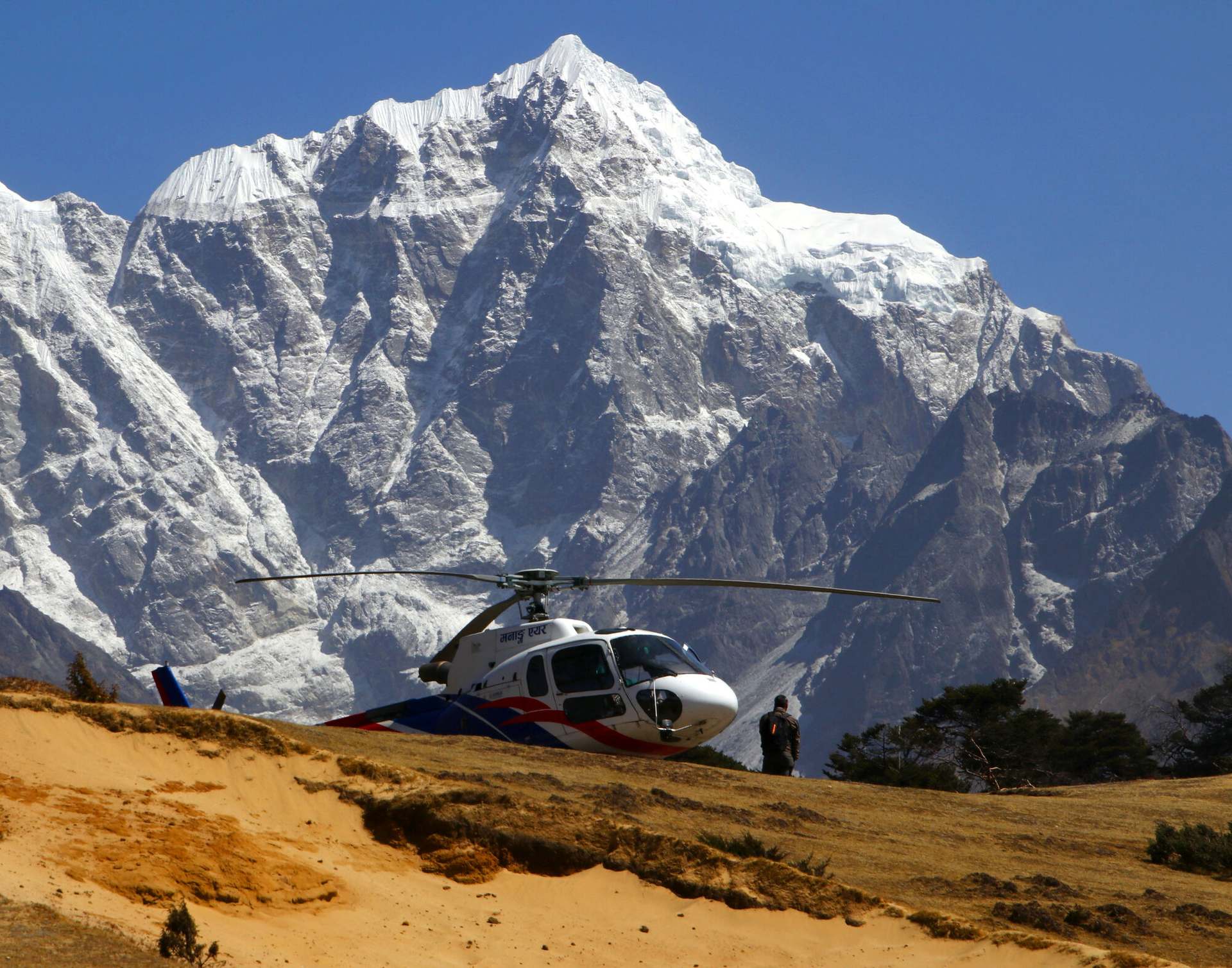
Photograph: © Brocken Inaglory / Wikimedia Commons · CC BY-SA 3.0
Twelve months, three elevations, one table. What the mountain is actually doing in the month you are thinking of going, and what to wear for it.
People ask how cold Mount Everest is as though it were one number. It is at least three: the summit, base camp and the valley you actually spend your time in are separated by more than three vertical kilometres, and in January they are separated by nearly 50 °C.
Here is the year, month by month, at the three elevations that matter. How cold Mount Everest is in general is the standing answer; this is the answer for the month you are actually going.
| Months | Summit, 8,848 m | Base camp, 5,364 m | What it means for flying |
|---|---|---|---|
| January–February | About −36 °C (−33 °F) | Nights below −25 °C, deserted | Coldest of the year, and the clearest air Nepal gets |
| March–May | −26 °C in April, −19 °C by late May | 0 to 5 °C in the sun on a clear day | Climbing season; haze builds through the season |
| June–September | About −19 °C (−2 °F) in July, the year's warmest | Monsoon cloud, not cold, is the problem | Valley closed for days at a time; operators cancel |
| October–December | About −27 °C | About −6 °C averaged over day and night | The best flying of the year, and the busiest |
Averages, not a forecast — a summit temperature is a modelled figure rather than a measurement. Live departures for the month you are choosing are on the Everest Base Camp helicopter tour page, and which season to book goes into the trade-offs.
How cold is Mount Everest in January and February?
The summit averages around −36 °C (−33 °F) and the jet stream sits on it almost continuously, with sustained winds over 160 km/h. Base camp is deserted; nights there fall below −25 °C.
The compensation is the air. Winter is the clearest, driest visibility Nepal gets, and a Khumbu morning in February can be flawless. Flights operate; you simply need to be dressed for the twelve minutes you spend outside the aircraft.
What is the temperature on Everest in spring?
The summit warms from −26 °C in April towards −19 °C by late May, and the jet stream begins to lift north. That lull is the climbing window, and it is the only season when Everest Base Camp exists as a settlement rather than as a patch of moraine.
Down at 5,364 m a clear spring day is 0 to 5 °C in the sun. The haze builds through the season, so early spring gives better photographs than late.
Which is the warmest month on Mount Everest?
July is the warmest month on the summit at about −19 °C (−2 °F), which tells you how little warmth means up there. The problem is not temperature, it is cloud: the valley closes for days at a time and operators cancel rather than push.
Kathmandu is at its warmest and wettest, around 25 °C. If your dates are fixed inside monsoon, budget spare days and treat the flight as a bonus.
How cold is Everest Base Camp in October and November?
The monsoon has washed the haze out and the winter winds have not yet arrived. The summit is back to about −27 °C, base camp runs −6 °C on average across day and night, and the Khumbu is visible almost every morning.
It is also the busiest and priciest window. Two to four weeks ahead for a shared seat, longer for a private aircraft on a fixed date.
How do you work out the temperature at any altitude?
Air cools about 6.5 °C for every 1,000 m of height. Kathmandu at 1,400 m and 20 °C implies roughly −28 °C at the summit on arithmetic alone, before wind or radiation are counted.
That single rule will get you closer to the right clothing than any monthly average, because what changes most across the year is not the temperature — it is the visibility.
FAQs
What is the coldest month on Mount Everest?
January and February are the floor of the year on Everest. The summit averages around −36 °C (−33 °F) with the jet stream sitting on it almost continuously at sustained winds over 160 km/h, and nights at base camp fall below −25 °C. The compensation is visibility: winter gives the clearest, driest air Nepal sees all year.
What is the warmest month on the summit of Everest?
July is the warmest month on the Everest summit at about −19 °C (−2 °F), which is a useful measure of how little warmth means at 8,848 m. July is also the middle of the monsoon, so the obstacle to flying then is cloud rather than temperature — the valley closes for days at a time.
How cold is Everest Base Camp during the day?
On a clear spring day at Everest Base Camp, 5,364 m, the temperature in the sun is roughly 0 to 5 °C. Across October and November base camp averages about −6 °C taken over day and night together, so the daytime figure and the overnight figure are very different numbers.
How do you estimate the temperature at the summit of Everest?
Air cools about 6.5 °C for every 1,000 m of height gained, so Kathmandu at 1,400 m and 20 °C implies roughly −28 °C at the summit on arithmetic alone, before wind or radiation are counted. That single rule gets you closer to the right clothing than any monthly average, because what changes most across the year is visibility rather than temperature.
Ready to fly this route?
Compare every licensed operator that flies it, with seat and whole helicopter prices side by side.
See operators and pricesThe full answer, kept up to date: How cold is Mount Everest?