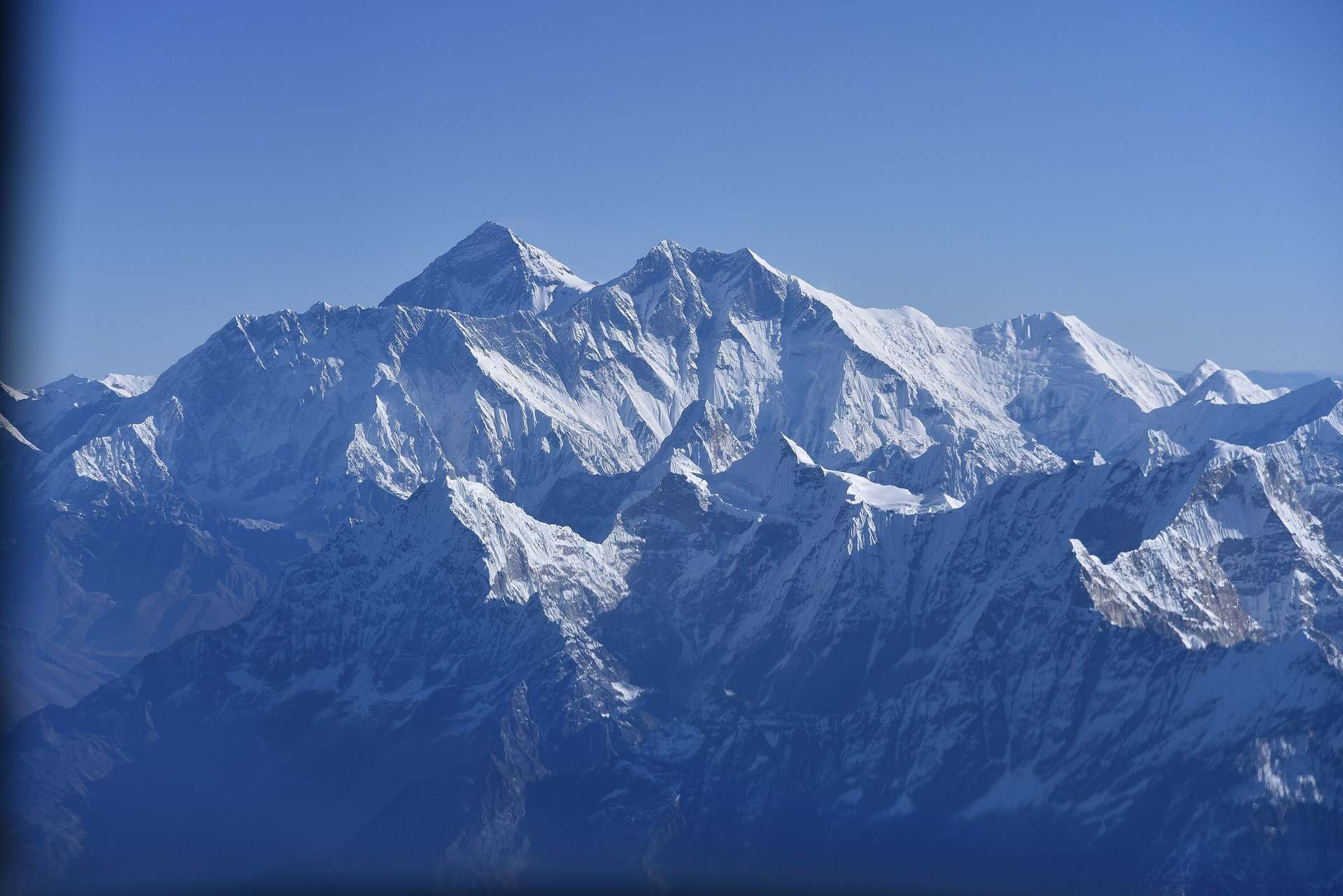
 © shankar s. / Wikimedia Commons · CC BY 2.0
What does an Everest helicopter tour cost?
Reviewed · 6 min read
How much does an Everest Base Camp helicopter tour cost?
A shared seat on an Everest Base Camp helicopter tour from Kathmandu costs roughly US$500 to US$650 per person, and chartering the whole aircraft for up to five passengers costs roughly US$3,800 to US$4,800. The spread is not a quality difference: identical itineraries are priced differently by different operators depending on where their aircraft already is that morning and how full their schedule is. Tours that land at Kala Patthar or Everest Base Camp sit at the top of those ranges; flights that view the mountain without a high landing sit at the bottom. Landing fees, national park permits and the breakfast stop at Hotel Everest View are included by most operators but not all — always compare the total rather than the headline.
- Shared seat
- About $500–650 per person
- Whole aircraft
- About $3,800–4,800
- Passengers per aircraft
- Up to 5
- Total trip time
- About 4 hours, Kathmandu return
- Time on the ground at altitude
- 10–15 minutes
- Cheapest month
- None — price moves with demand, not season
The two ways to buy it
A shared seat means you join a group of up to five and pay per person. It is far and away the cheaper route, and for most travellers it is the right one: the aircraft, the itinerary and the view are identical.
Chartering the whole helicopter means the aircraft is yours, the departure time is negotiable, and nobody else's schedule can move yours. It costs roughly seven to eight times a single seat, which makes it good value for a group of four or five and expensive for a couple.
| Tour | Per shared seat | Whole aircraft | Duration |
|---|---|---|---|
| Everest Base Camp tour, Kala Patthar landing | $499–575 | $3,800–4,500 | 4 hours |
| Everest Base Camp landing tour | $625–650 | $4,600–4,800 | 4–5 hours |
| Lukla charter, one way | $599–650 | $2,600–2,900 | 50 minutes |
Why the same flight has five prices
Nepal's helicopter market is a set of independent operators, each pricing its own aircraft. On an identical Everest itinerary the spread between the cheapest and dearest shared seat is regularly fifteen per cent, and on a private charter it is several hundred dollars.
Almost none of that correlates with quality. The cheapest operator on a given morning is usually the one with an aircraft already positioned where your flight starts, or with a gap in a schedule it would rather fill than fly empty. Fleet age, maintenance cycles and plain commercial appetite account for the rest.
What does not vary is certification. Every operator listed here holds a current Air Operator Certificate and comes off the site the day one lapses. That is the floor, not a feature.
What the price should include
A complete Everest tour price covers the flight itself, the Lukla refuelling stop, landing fees at the high site, the Sagarmatha National Park entry permit, and breakfast at Hotel Everest View. Some operators quote before permits and fees and add them afterwards, which is how a $499 seat becomes a $560 seat at the desk.
Not included, anywhere: travel insurance, your own warm clothing, and anything that happens if the weather stops the flight. A cancelled flight is refunded or rescheduled — you are not charged for a flight that does not happen — but the hotel night you booked around it is yours.
When you are actually paying more
Two things genuinely move the price rather than merely varying it. The first is a high landing: putting the aircraft down at Kala Patthar or base camp means extra flying, extra fees and a longer day than a viewing flight, and it costs $100 or so more per seat.
The second is season. October–November and March–May are the clear-air months, everybody wants them, and prices sit at the top of the range with availability at the bottom. Monsoon is cheap because the flight frequently does not go.
How to compare honestly
Compare the total, not the headline. Ask what is included, confirm whether the quoted price is per seat or per aircraft, and check the landing site by name — "Everest Base Camp tour" is used by some operators for flights that never land above 4,000 m.
Then look at whether they answer. A cheap seat from an operator who takes three days to reply is not a bargain in a business where the weather changes your plans overnight.
FAQs
How much is a helicopter tour to Everest Base Camp?
A shared seat costs roughly US$500 to US$650 per person from Kathmandu, and the whole helicopter for up to five passengers costs roughly US$3,800 to US$4,800. Tours that land high, at Kala Patthar or base camp itself, sit at the top of both ranges.
Is the Everest helicopter tour worth the money?
It replaces a twelve-day trek with a four-hour morning and puts you at 5,545 m looking at the south face of Everest. For travellers without the time, the fitness or the acclimatisation for the walk, it is the only way to see that view. It is not a cheap morning, and everyone who has taken it describes it as a once-only expense rather than a bargain.
What is included in an Everest helicopter tour price?
A complete price covers the flight, the Lukla fuel stop, landing fees at the high site, the Sagarmatha National Park permit and breakfast at Hotel Everest View. Insurance, warm clothing and any accommodation around a weather delay are not included. Some operators quote before permits and fees, so confirm the total before booking.
Do I get a refund if the Everest helicopter tour is cancelled for weather?
Yes. You are not charged for a flight that does not operate, and operators will either refund or reschedule. What is not recoverable is anything you booked around the flight, which is why travellers on tight itineraries are advised to keep a spare morning.
Is it cheaper to fly to Everest Base Camp as a group?
Yes, substantially. Chartering the whole aircraft costs about seven to eight times one shared seat but carries up to five passengers, so a group of five pays little more per head than the shared price while controlling the departure time. For one or two travellers, a shared seat is far better value.
Related reading: The same flight, five prices: why comparing operators matters