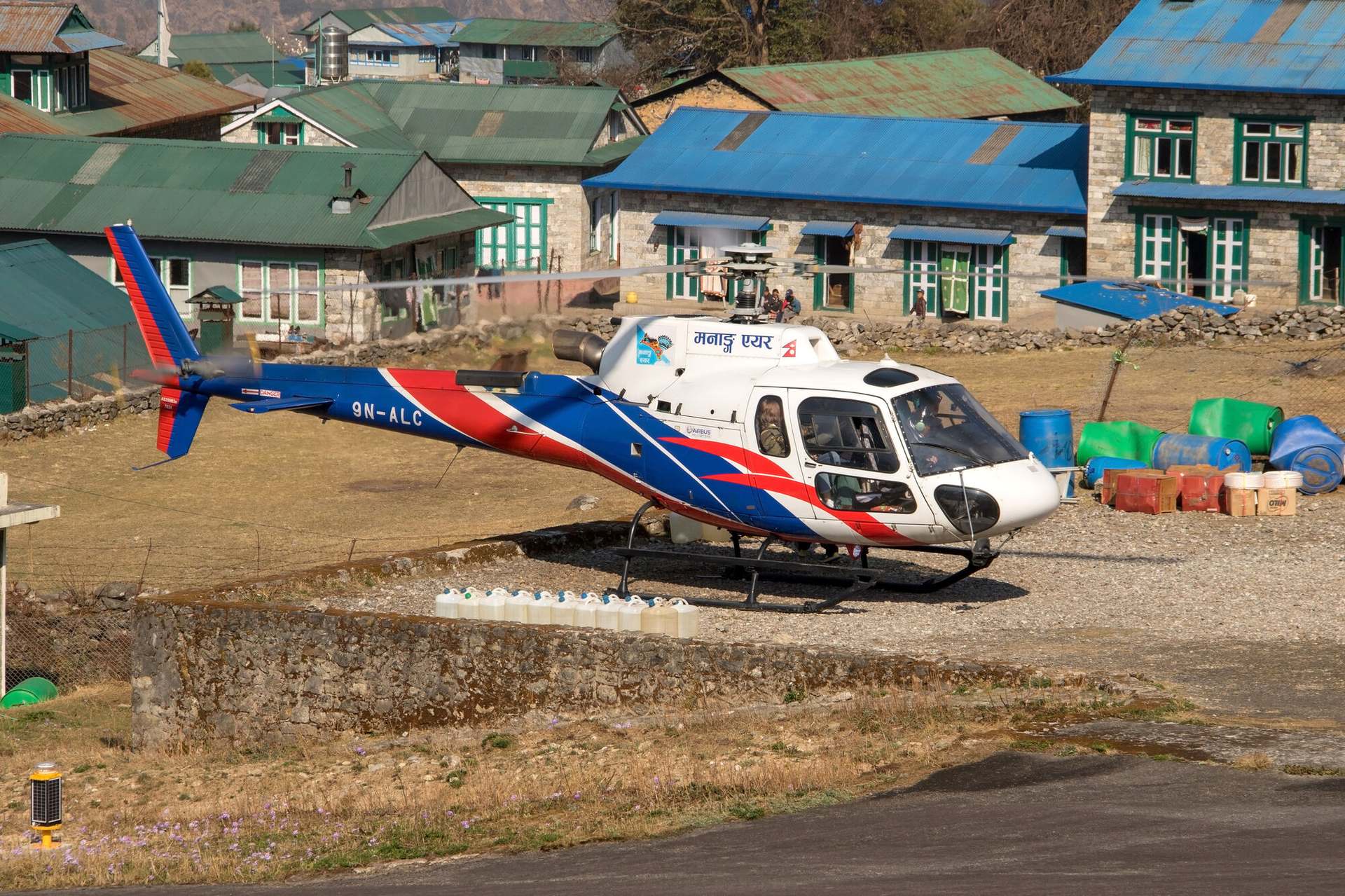
 © hsvgerrit / Wikimedia Commons · CC BY 4.0
Flying from Kathmandu to Lukla
Reviewed · 6 min read
How do you fly from Kathmandu to Lukla?
The flight from Kathmandu to Lukla takes 25 to 35 minutes in a fixed-wing aircraft and costs roughly US$180 to US$220 one way for foreign nationals. It lands at Tenzing–Hillary Airport (LUA), elevation 2,845 m (9,334 ft), which has a 527 m runway on an 11.7 per cent uphill gradient and is the nearest airport to Mount Everest. In the peak trekking months the fixed-wing service is frequently moved to Manthali airport in Ramechhap, four to five hours by road from Kathmandu, which turns a 30-minute flight into a pre-dawn drive. Lukla closes for weather often enough that a spare day either side is standard advice, and a helicopter charter is the usual way through a backlog when it does.
- Airport
- Tenzing–Hillary · LUA · VNLK
- Elevation
- 2,845 m · 9,334 ft
- Runway
- 527 m, 11.7% uphill
- Flight time from Kathmandu
- 25–35 minutes
- Fixed-wing fare, one way
- About $180–220
- Lukla to Everest Base Camp on foot
- 3–5 days up
The airport everything depends on
Tenzing–Hillary Airport at Lukla is the gateway to the Everest region and the nearest airport to the mountain itself. It sits at 2,845 m (9,334 ft) on a shelf above the Dudh Koshi, and its 527 m runway is built on an 11.7 per cent uphill slope with a mountainside at the top and a drop at the bottom.
The gradient is a safety feature, not a quirk. Aircraft land uphill, which slows them without brakes, and take off downhill, which accelerates them in thin air. There is no go-around on the approach: a pilot commits to the landing, and that is why the airport is flown by experienced crews in specific aircraft and by nobody else.
Schedules, fares and the Ramechhap problem
Flights operate in the morning, because the Khumbu valley reliably clouds over by early afternoon. A fixed-wing seat costs roughly US$180 to US$220 one way for foreign nationals, with lower fares for Nepali citizens, and the aircraft are 15- to 19-seat turboprops.
In the peak trekking seasons the flights are often moved out of Kathmandu altogether to Manthali airport in Ramechhap, which is four to five hours away by road. The flight itself then takes about 12 minutes; the day still starts at one in the morning. Whether the switch applies in a given season changes, so confirm the departure airport when you book rather than when you check in.
| Option | Time | Indicative cost | Reliability |
|---|---|---|---|
| Fixed-wing, Kathmandu–Lukla | 25–35 min | $180–220 per seat | Weather-dependent |
| Fixed-wing via Manthali | 4–5 h road + 12 min | $180–220 per seat | Same, plus a drive |
| Helicopter, shared seat | About 50 min | $599–650 per seat | Flies in more marginal conditions |
| Helicopter charter | About 50 min | $2,600–2,900 | Departs when you do |
When Lukla is closed
Lukla closes for cloud, wind or rain regularly, and it does not close for an hour — it closes for the day, and the passengers from that day are added to the next. Two consecutive bad days in October produce a backlog it can take three days to clear, and the trekkers who booked earliest go first.
This is where the helicopter earns its price. A helicopter can operate in conditions that ground a fixed-wing aircraft on that approach, can fly when the queue at the airline desk is 200 people long, and departs when the weather opens rather than when a schedule says so. A shared seat is roughly $600, a charter roughly $2,700 — several times the aeroplane fare, and routinely paid by people who have a flight home to catch.
From Lukla to Everest Base Camp
Lukla is the start of the walk, not the end of it. Everest Base Camp is about 62 km away and 2,500 m higher, and the trek takes three to five days up depending on how much acclimatisation you build in, with two to three days back down. Eight to twelve days round trip is normal.
You cannot compress that safely on foot — the whole schedule exists to let your body adapt to altitude. What you can do is fly one leg: helicopter returns from Lukla, Namche or Gorak Shep are common, and they turn a four-day walk-out into an hour.
Is Lukla actually the nearest airport to Everest?
Yes. Nothing else is close. Lukla is the only airport serving the Khumbu, and Kathmandu's Tribhuvan International is the nearest international arrival point, about 140 km away and a world of altitude below.
There is also Syangboche, a dirt strip above Namche Bazaar at 3,748 m, but it is not a scheduled airport and is used almost exclusively by helicopters.
FAQs
How long is the flight from Kathmandu to Lukla?
Between 25 and 35 minutes in a fixed-wing aircraft, and about 50 minutes by helicopter. If the service has been moved to Manthali in Ramechhap for the season, the flight itself is around 12 minutes but is preceded by a four- to five-hour road transfer from Kathmandu.
How much does a flight from Kathmandu to Lukla cost?
Roughly US$180 to US$220 one way for foreign nationals on a scheduled fixed-wing flight, with lower fares for Nepali citizens. A shared helicopter seat on the same sector is around US$600, and chartering the whole helicopter is around US$2,700.
What is the nearest airport to Mount Everest?
Tenzing–Hillary Airport at Lukla, at 2,845 m (9,334 ft), is the closest airport to Mount Everest and the gateway to the whole Khumbu region. The nearest international airport is Tribhuvan in Kathmandu, about 140 km away.
Why are Lukla flights cancelled so often?
The approach has no instrument procedure and no possibility of a go-around, so it requires clear visual conditions. Cloud, wind or rain closes the airport for the whole day rather than briefly, and the delayed passengers roll into the following day's flights, which is how a two-day weather closure becomes a four-day backlog.
How high is Lukla?
Lukla sits at 2,845 m (9,334 ft). That is high enough for altitude to be noticeable on arrival, particularly for anyone flying straight in from Kathmandu at 1,400 m, and it is why the first day of the trek is a short one.
Can I fly a helicopter from Kathmandu to Lukla instead?
Yes, and many people do when the fixed-wing schedule collapses. Helicopters operate in more marginal conditions than the aeroplanes on that approach and depart on your timing rather than an airline's. Expect around US$600 for a shared seat or US$2,700 to charter the aircraft.
Related reading: 527 metres, uphill: reading Lukla's runway