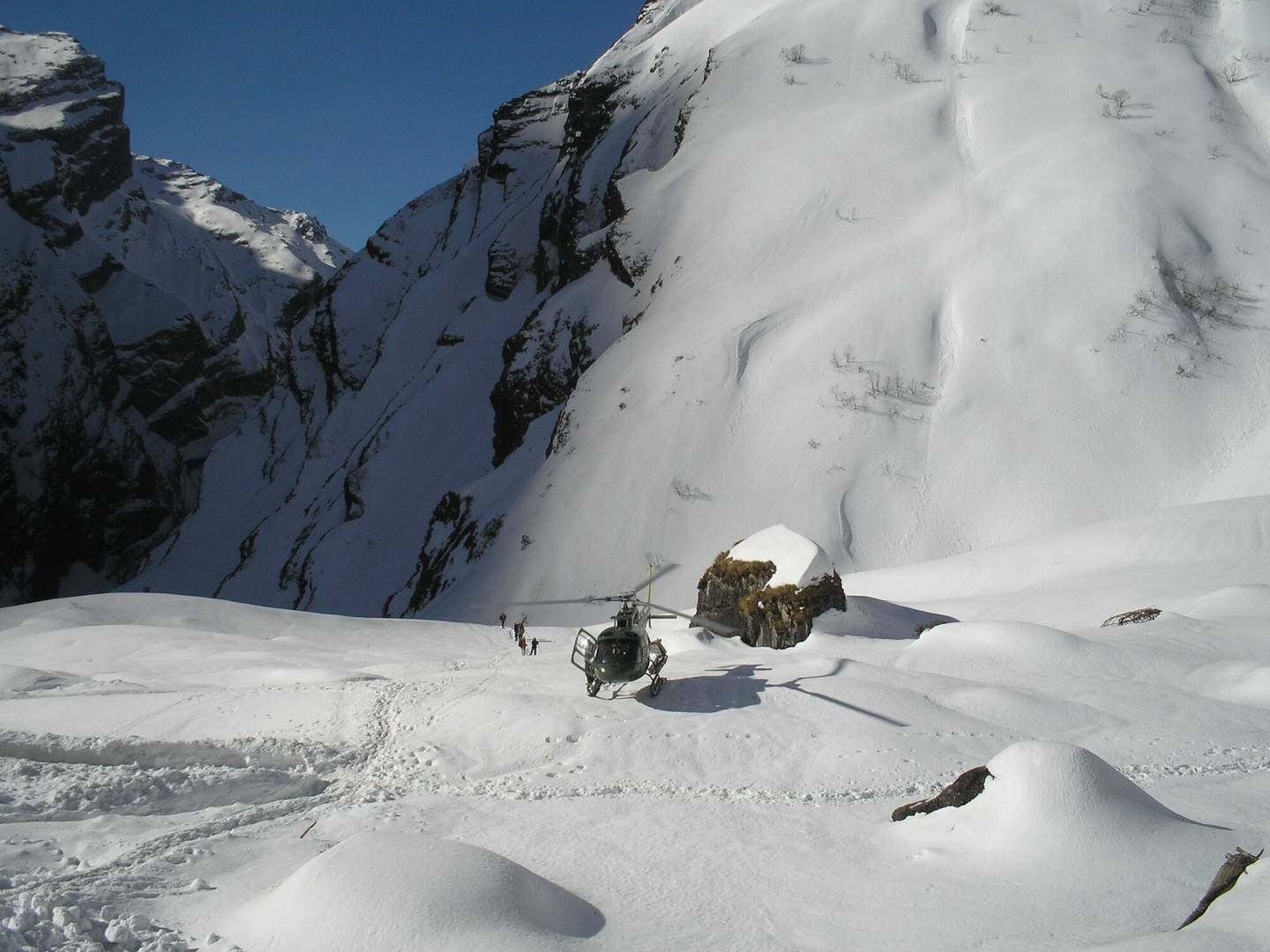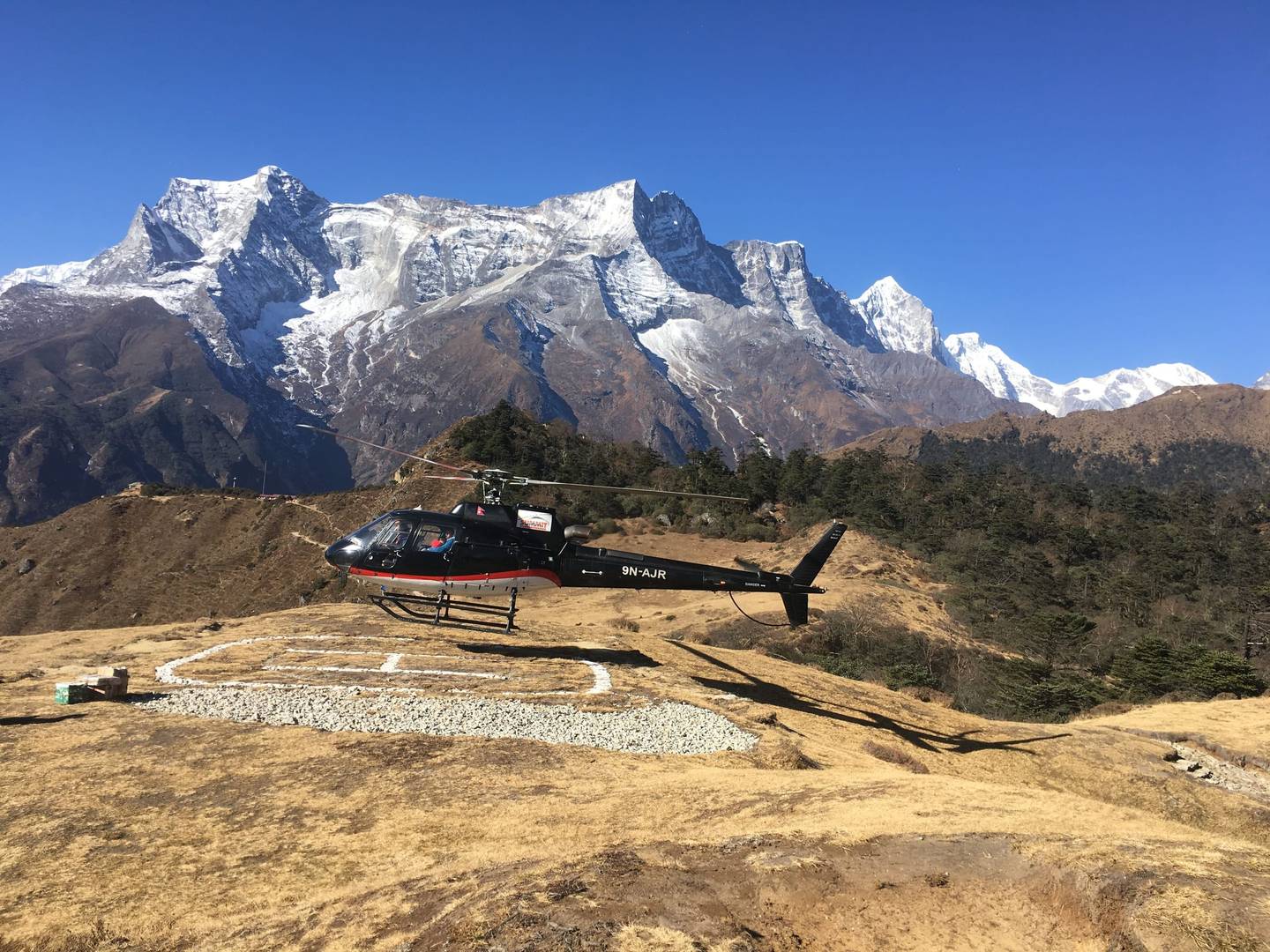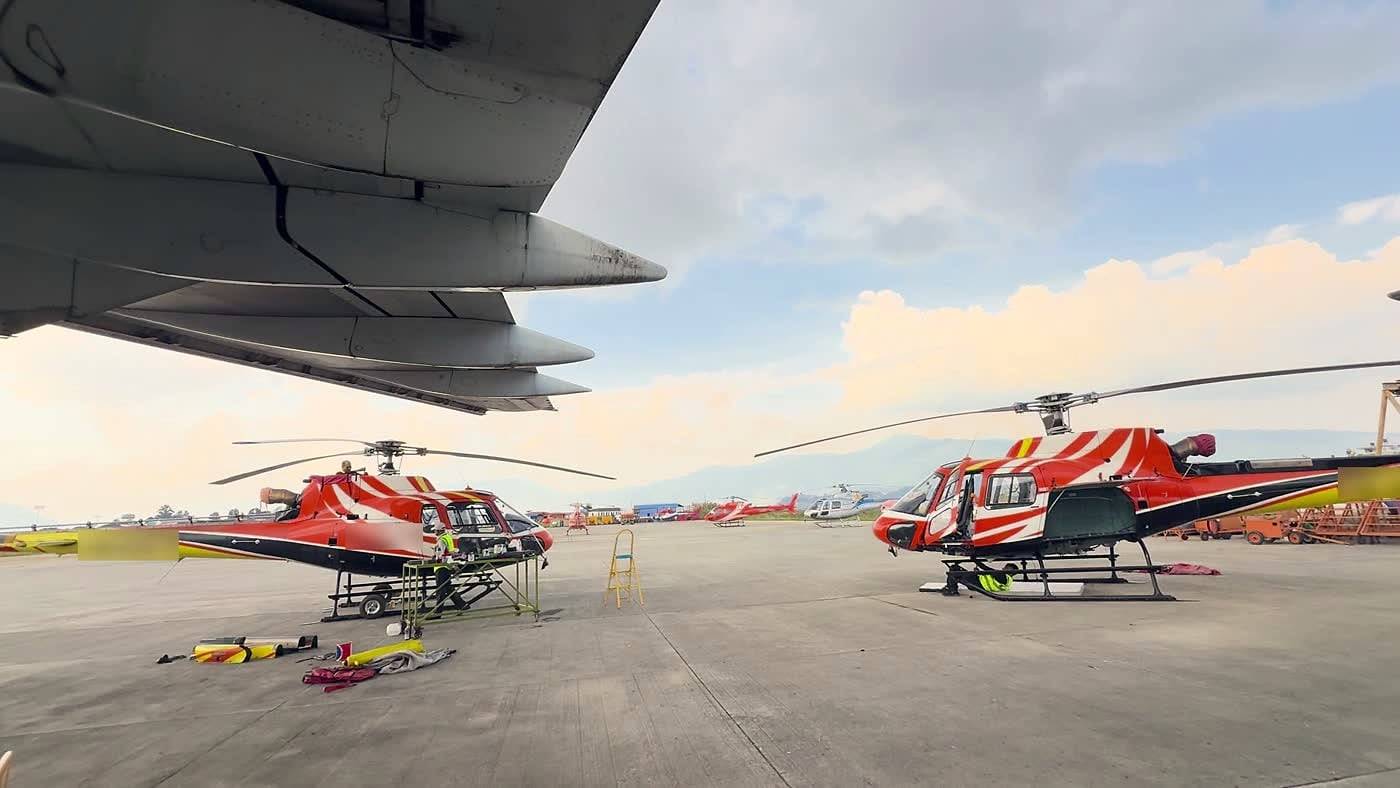

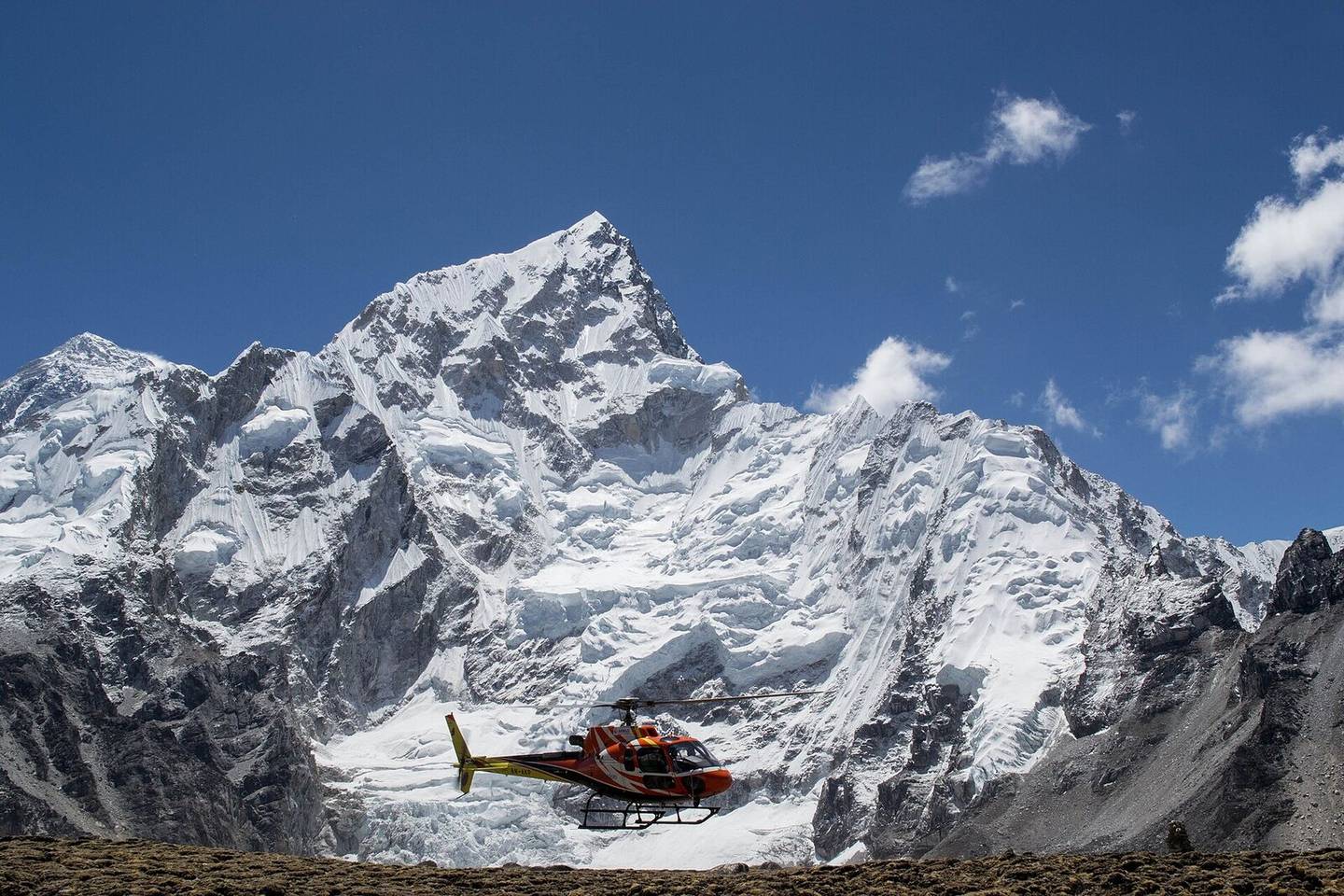
A helicopter rate in Nepal is a price for one hour of block time, measured engine start to engine stop. The hour carries the aircraft, the crew and, on a wet rate, the fuel. It does not carry the sectors you do not ride, the operator's daily minimum, or permits. Most of that flying starts at Kathmandu's Tribhuvan International Airport, 1,338 m above sea level.
The eastern work runs to the Khumbu through Tenzing–Hillary Airport at Lukla, 2,845 m, and the western work runs through Pokhara. Go Heli Nepal's charter page carries the current hourly range, and certified operators price the actual leg. This page is what sits inside that hour: the fuel, the overhaul reserves, the empty sectors and the arithmetic that turns a flight time into a bill. What the wider market charges, and why two published figures for one flight so rarely compare, is the subject of our guide to helicopter price in nepal.
What does an hour on a helicopter rate actually buy in Nepal?
Block time, which is not flying time. The meter runs from engine start to engine stop, so it takes in taxi, run-up, shutdown and any period the aircraft waits with its rotors turning.
That makes the billed hour longer than the hour a route page advertises. The working rule is to take the advertised flying time and add about a fifth.
Two quote shapes are in use. An hourly quote sells you minutes. A fixed price for a named sector sells you the journey.
Which shape you hold decides who pays when the weather holds the aircraft on the ground. Under an hourly quote the extra minutes are yours from the first one. Under a fixed sector price the long day is the operator's cost.
Every one of those flights runs under an Air Operator Certificate issued by the Civil Aviation Authority of Nepal. CAAN's Aviation Safety Report 2025 counts 21 operators in service, 12 of them flying helicopters. The certificate is a floor each of them meets equally rather than a grade some meet better, so a cheap rate and an expensive one carry identical permission to fly. Go Heli Nepal passes a request to certified operators and it becomes a booking when one accepts; the aircraft, the crew and the passenger liability cover are theirs.
The one hourly figure the Nepali industry ever published for itself is eight years old. Aviation Nepal, reporting the Airlines Operators Association of Nepal's schedule effective September 2018, put charter and rescue flying for foreign nationals at US$2,000 an hour. That is not a quote for today and nothing comparable has been published since. What survives from it is the shape: by the hour, in dollars, and different by nationality.
| Item | Inside the hourly rate? |
|---|---|
| The aircraft and its crew | Inside |
| Fuel | Inside a wet rate; extra on a dry rate |
| Positioning sectors | Billed, usually at the same rate |
| Waiting with rotors turning | Inside, as block time |
| Landing and airport charges | Usually passed through |
| Park entry and restricted-area permits | Usually outside |
No money in this table on purpose: the shape is stable and the rates are not. Last checked 18 November 2026.
What is inside one hour of helicopter time?
Four lines, and only one of them is fuel.
Fuel is the variable line, and in Nepal it is the one that has moved. It is worked out in the next section.
Maintenance reserves are the line most readers have never heard of. A turbine engine and a main gearbox are overhauled after a fixed number of flown hours, so an operator accrues the cost of the next overhaul on every hour it flies. The reserve is the overhaul price divided by the overhaul interval.
Robinson publishes that arithmetic for its own aircraft, which is the clearest place to see the method. Its cost sheet of 15 January 2024 for the R44 reserves against a 2,200-hour engine overhaul and a 2,200-hour airframe overhaul parts kit, and puts the combined reserve near US$126 an hour. Enstrom's published sheet for the E-480 divides each gearbox overhaul by its own interval the same way. Neither aircraft is what flies in the Khumbu; the arithmetic is identical for the ones that do.
Crew, insurance, hangarage and the engineering organisation are the third line. They are paid by the year and recovered by the hour.
The fourth is the aircraft itself, which loses value against both flown hours and calendar time whether it flies or not.
So an hourly rate is not a measurement of what an hour costs. It is the annual costs divided by the hours the operator expects to fly, plus the cost of the hour itself. That division is why the same aircraft is priced differently in a busy season and a thin one.
| Line | What it pays for | What moves it |
|---|---|---|
| Fuel | The Jet A-1 burned in the hour | Pump price, load, altitude |
| Reserves | The next engine and gearbox overhaul | Overhaul price over its interval |
| Crew and cover | Pilots, training, insurance | Paid yearly, recovered hourly |
| Aircraft and overheads | Hangar, engineers, depreciation | Hours flown in the year |
How many litres does a helicopter burn an hour, and what does that cost in Nepal?
Between about 180 and 200 litres an hour for an Airbus H125, the AS350 B3 that does most of Nepal's high-altitude work.
The published figures cluster tightly. An Airborne Operations specification sheet for the H125 gives 180 litres an hour and converts it to 47.6 US gallons. Access Helicopters and High Terrain Helicopters both publish 190 litres an hour for the AS350 B3. A pilot describing a fully loaded B3 in warm air put it near 195.
Airbus gives the type a single 540-litre crash-resistant tank in its technical description. At 190 litres an hour that is under three hours of cruise before any reserve, which is why Khumbu work refuels at Lukla rather than flying a round trip on one tank.
Now the arithmetic no rate guide does. Nepal Oil Corporation sets the domestic price of aviation turbine fuel, and its own retail schedule puts it at NPR 249 a litre with effect from 2 August 2026; an independent Nepali fuel-price tracker lists the same figure. Multiply it by the burn: 180 to 200 litres an hour at NPR 249 is roughly NPR 45,000 to NPR 50,000 of fuel inside every hour flown. In the cruise that is about NPR 790 a minute.
That figure is worth carrying because the pages ranking for helicopter rates do not carry it. One Nepali operator's guide puts the burn at 120 to 150 litres an hour and the fuel cost at US$400 to US$700, which is below every manufacturer and operator figure above and names no fuel price at all. The international charter guides say fuel is a major cost and then give an hourly band with no fuel price behind it.
Nepal Oil Corporation revises the price periodically, so treat NPR 249 as the figure for August 2026 rather than for the day you read this. The burn rate is the stable half of the calculation; the pump price is not.
| Input | Figure | Named source |
|---|---|---|
| Burn, Airbus H125 | 180–200 litres an hour | Operator and dealer sheets |
| Usable tank | 540 litres | Airbus technical description |
| Domestic Jet A-1 | NPR 249 a litre | Nepal Oil Corporation |
| Fuel in one hour | About NPR 45,000–50,000 | The two above, multiplied |
Nepal Oil Corporation's domestic aviation turbine fuel price, effective 2 August 2026 and revised periodically. Burn figures are cruise planning figures, not flight-manual numbers for a given load. Last checked 18 November 2026.
Why did helicopter rates in Nepal move in 2026?
Because the fuel line roughly doubled, and then the hours it was spread over fell.
Nepal Oil Corporation raised the domestic price of aviation turbine fuel in early April 2026. The Kathmandu Post reported the domestic rate going from NPR 127 a litre to NPR 251, an increase of about 97.6 per cent, and the international rate rising 77.63 per cent to US$1,716 a kilolitre at Kathmandu. StratNews Global and Nepali Times reported the same near-doubling.
Put that through the burn rate. At 190 litres an hour the fuel inside one hour went from about NPR 24,000 to about NPR 48,000. The aircraft, the route and the crew did not change.
Then came the second effect, which is the one no price guide writes down. The Kathmandu Post reported in July 2026 that flight hours across Nepal's helicopter operators had fallen by 20 to 30 per cent, and that domestic passenger numbers were down by more than 540,000 in the financial year that ended on 16 July.
Fewer hours flown does not reduce the hangar, the engineers, the insurance or the certificate. Those are annual costs recovered per hour, so the same bill is divided among fewer hours. A fuel shock therefore raises an hourly rate twice: once through the fuel itself, and again through the thinner utilisation it causes.
The Airlines Operators Association of Nepal added a third pressure at the time, arguing that most aviation expenses in Nepal are denominated in US dollars while much of the revenue is not.
This is the honest reason a rate guide written in 2025 and one written in 2026 disagree about Nepal without either being dishonest. Ask when a figure was set before deciding it is wrong.
How do you turn a flight time into the hours you will be billed?
Multiply the advertised flying time by the number of sectors the aircraft flies, then add about a fifth for block time.
The sector count is where most arithmetic goes wrong. On a sightseeing circuit you ride every sector the aircraft flies. On a one-way transfer you ride one and the aircraft flies at least two, because it still has to get home. If the aircraft is not where you are when you book, there is an empty sector in front of yours as well.
Worked on a route this site publishes surveyed figures for. Kathmandu to Lukla is 72.94 nautical miles in a straight line, which is 37 minutes of air time at 120 knots. One-way, the aircraft flies that twice, so 74 minutes. Add the fifth and it is about an hour and a half of block time for a 37-minute ride.
The fuel alone inside that hour and a half is about 285 litres, which at the August 2026 price is roughly NPR 71,000.
So the rule of thumb for Nepal is short: advertised flight time, doubled for a one-way, plus a fifth. It is the fastest way to tell whether a quote tracks the aircraft's real time or sits well above it.
Then check the answer against the minimum, because below the minimum the arithmetic stops applying. Charter guides elsewhere describe minimum billing of 30 to 60 minutes a flight; in Nepal the floor is more often a day, because an aircraft committed to your morning cannot be sold to anybody else. On a short sector it is the minimum rather than the rate that sets the bill.
Working the flight time itself out, leg by leg and with the climb accounted for, is the other half of this arithmetic; our helicopter flight time calculator for Nepali routes does that part.
| Step | Minutes |
|---|---|
| Air time, Kathmandu to Lukla | 37 |
| The empty return sector | 37 |
| Block time, adding a fifth | About 89 |
| Billed, in hours | About 1.5 |
Air time computed from this site's surveyed coordinates at a published cruise of 120 knots. A positioning leg before your flight adds another sector.
What should you ask before you accept an hourly rate?
Five questions, and the rate is not one of them.
Ask whether the rate is wet or dry. A wet rate includes the fuel and a dry rate does not, with the fuel charged separately. With fuel at roughly NPR 45,000 to NPR 50,000 an hour, a dry rate that looks cheaper usually is not.
Ask how many sectors the quote covers, and whether positioning is billed at the same hourly rate. Charter rate sheets generally say it is.
Ask what the minimum is, in hours or in days.
Ask who carries a weather hold: you under an hourly quote, the operator under a fixed sector price.
Ask what sits outside the number — landing and airport charges, 13 per cent VAT, national park entry, restricted-area permits, and crew costs if the aircraft stays out overnight.
What no rate can tell you is whether you will fly. Weather closes Lukla for days at a time in the monsoon, and no operator in Nepal will promise a departure slot, so a rate with spare days built around it is worth more than a lower one with none.
Questions this article answers
How many litres of fuel does a helicopter use per hour?
An Airbus H125, the AS350 B3 that flies most of Nepal's high-altitude work, burns between about 180 and 200 litres of Jet A-1 an hour. An Airborne Operations specification sheet for the type gives 180 litres an hour, or 47.6 US gallons; Access Helicopters and High Terrain Helicopters both publish 190. Airbus lists a single 540-litre tank in its technical description for the type, which at 190 litres an hour is under three hours of cruise before any reserve.
What does helicopter fuel cost per litre in Nepal?
Nepal Oil Corporation sets the domestic price of aviation turbine fuel, and its retail schedule put it at NPR 249 a litre with effect from 2 August 2026. The price moved sharply that year: the Kathmandu Post reported the domestic rate rising from NPR 127 a litre to NPR 251 in early April 2026, an increase of about 97.6 per cent, which StratNews Global and Nepali Times also reported. Nepal Oil Corporation revises the figure periodically, so it should be read with its date attached rather than as a standing price.
Is a helicopter rate quoted per flying hour or per hour of block time?
A helicopter rate in Nepal is quoted per hour of block time, measured from engine start to engine stop rather than from take-off to landing. Block time takes in taxi, run-up, shutdown and any period the aircraft waits with its rotors turning, so it always exceeds the flying time a route page advertises. The usual correction is to add about a fifth to an advertised flight time before multiplying by a rate. A quote described as a fixed price for a named sector is the other shape, and its total does not move when the day does.
Why is a helicopter hourly rate higher when an operator flies fewer hours?
A helicopter hourly rate is partly annual cost divided by hours flown, so fewer hours means each remaining hour carries more of the hangar, the engineers, the insurance and the certificate. Those costs do not fall when the aircraft sits. This is why a fuel shock raises a rate twice over: the Kathmandu Post reported in July 2026 that flight hours across Nepal's helicopter operators had fallen by 20 to 30 per cent after the April fuel increase, which left the same fixed bill spread across a smaller number of hours.
What is the difference between a wet rate and a dry rate on a helicopter charter?
A wet rate includes the fuel in the hourly figure, and a dry rate excludes it so the fuel is charged on top. The distinction matters more in Nepal than it used to, because fuel inside one hour of an Airbus H125 runs to roughly NPR 45,000 to NPR 50,000 at Nepal Oil Corporation's August 2026 domestic price. A dry quote therefore looks materially cheaper than a wet one for the same flying, and the two cannot be compared until you know which you hold.