How Fast Do Helicopters Fly?
Go Heli Nepal9 min read
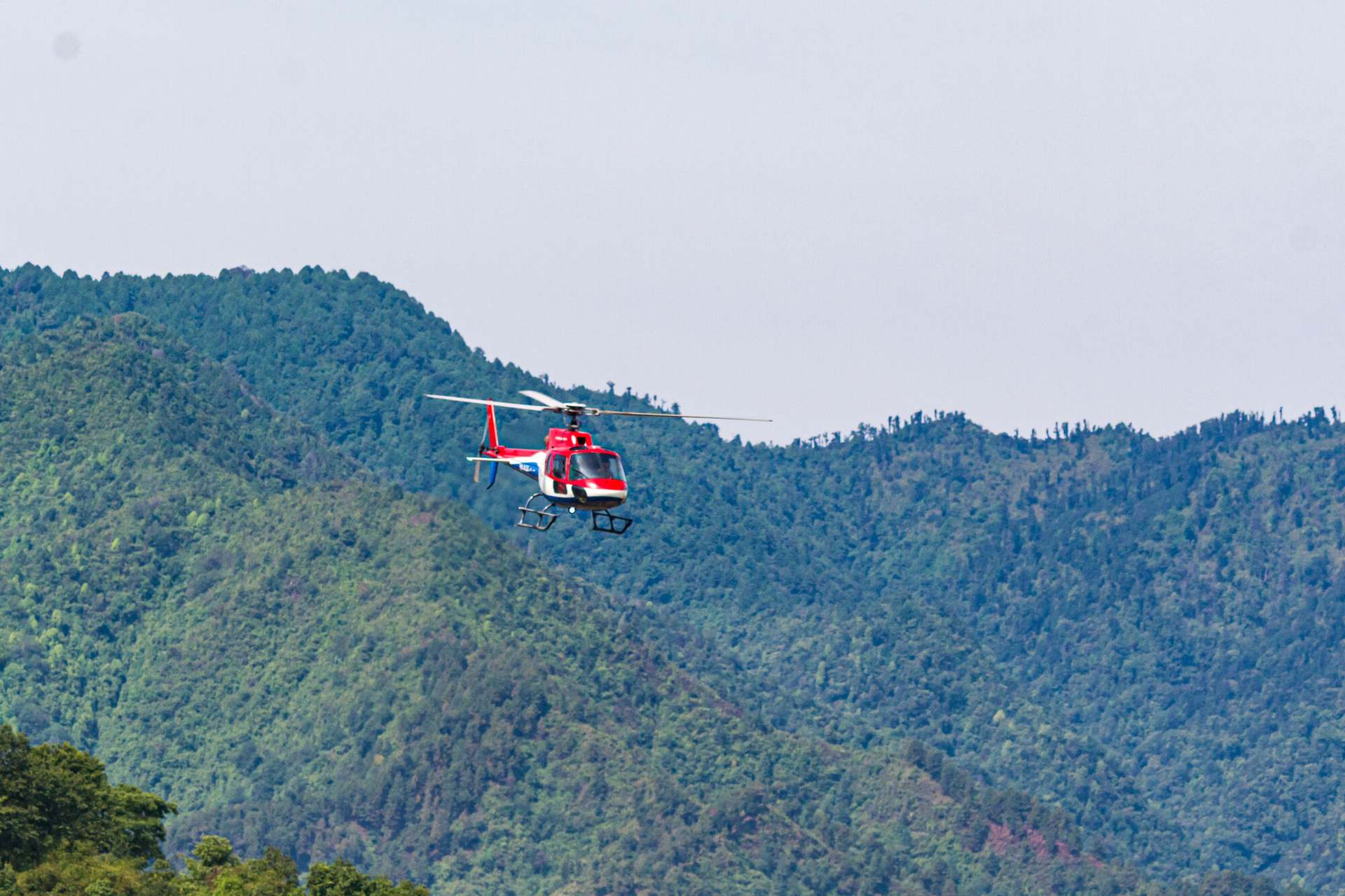
Photograph: © Vyacheslav Argenberg / Wikimedia Commons · CC BY 4.0
Most helicopters cruise between 110 and 140 knots. Airbus gives the H125, the type flying Nepal's Khumbu, a fast cruise of 136 knots, 252 km/h.
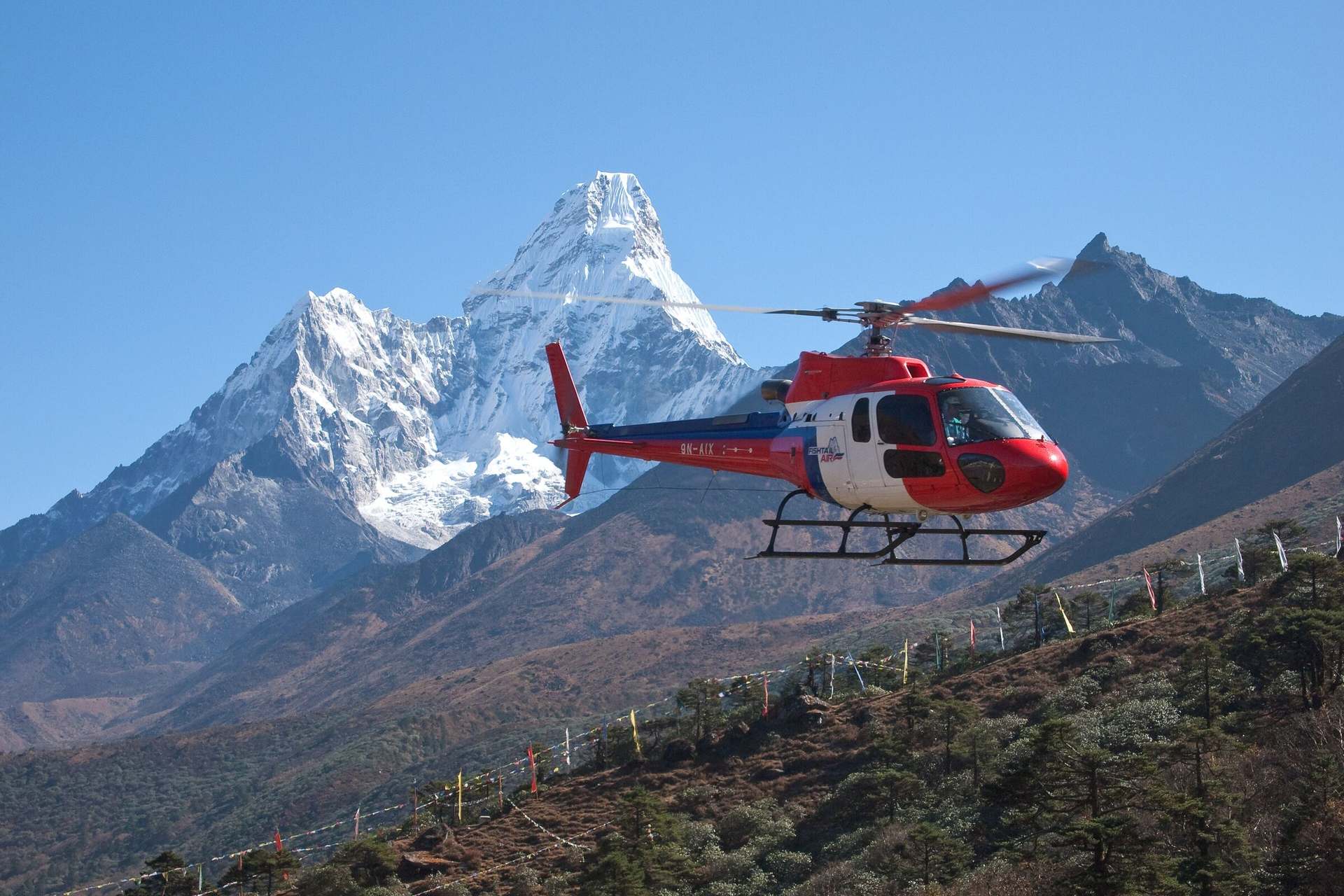
Most helicopters cruise between 110 and 140 knots — 200 to 260 km/h, or 125 to 160 mph. Airbus gives the H125 a fast cruise of 136 knots, 252 km/h, on its technical information page for the type. That is the aircraft doing most of the flying in Nepal's Khumbu, out of Tenzing–Hillary Airport at Lukla.
None of those figures is what a passenger experiences, and the reason is not the one most accounts give. Weight and height move every performance number a helicopter has — that is the subject of how helicopters perform in nepal — but speed is the number they move least.
How fast do helicopters go in normal service?
Between about 110 and 140 knots, for almost anything with one main rotor.
That band is narrow, and it has been narrow for fifty years. A helicopter's forward speed is set by what happens at the tips of its rotor blades rather than by how much power it has, so a bigger engine does not widen it.
The three types this platform lists for Nepal all sit inside it. Airbus publishes a fast cruise of 136 knots, 252 km/h, for the H125. GlobalAir and Airforce Technology both give the Bell 412EP a maximum cruise of 122 knots, 226 km/h, and a never-exceed speed of 140 knots, 259 km/h. The AS350 B3e on the same list is the same airframe as the H125 under its earlier name.
| Aircraft | Published speed | Where the figure comes from |
|---|---|---|
| Airbus H125 | 136 kt / 252 km/h fast cruise | Airbus technical information page |
| Bell 412EP | 122 kt / 226 km/h maximum cruise | GlobalAir and Airforce Technology |
| Westland Lynx G-LYNX | 400.87 km/h over a measured course | FAI record, 11 August 1986 |
Each figure was measured light, low and in standard air. None of them was measured at a Himalayan landing site.
Which number is being quoted when someone says a helicopter's speed?
One of five, and they are not interchangeable.
Cruise speed is what the aircraft holds in level flight at a normal power setting. Fast cruise is the same thing at a higher setting, and it is the figure manufacturers prefer to publish. Maximum speed is the fastest the aircraft will go in level flight. Never-exceed speed is not a performance at all but a limit, the speed past which the aircraft must not be flown.
Ground speed is the fifth, and it is the only one a passenger can feel. It is the aircraft's speed through the air plus or minus the wind, and it is what decides when you land.
Most articles answering this question give one number without saying which of the five it is. That is why their answers disagree with each other by forty knots and none of them is wrong.
How fast can a helicopter go, and why has the record stood since 1986?
400.87 km/h, or 249.09 mph, set on 11 August 1986 and never beaten.
John Trevor Egginton flew a Westland Lynx demonstrator, G-LYNX, over Glastonbury in Somerset, with Derek Clews beside him. Guinness World Records, Leonardo and the Fédération Aéronautique Internationale all carry the same figure.
The aircraft was not a production machine. Leonardo's own account of the flight describes experimental BERP main rotor blades and two Rolls-Royce Gem 60 engines with water-methanol injection, each rated at 1,345 shaft horsepower.
Set that beside the H125's 136 knots and the shape of the problem appears. The fastest helicopter ever flown managed roughly one and a half times the cruise of an ordinary utility single, and it needed a bespoke rotor to do it.
The limit is aerodynamic rather than mechanical. In forward flight one blade advances into the airflow and the opposite blade retreats from it. Pilot Institute puts the advancing tip of a typical turbine helicopter at about 295 metres a second at 150 knots of forward flight, against a sea-level speed of sound near 340 metres a second. Push the aircraft faster and that tip goes transonic, and drag climbs faster than any engine answers it. Slow the rotor to avoid that and the retreating blade runs out of airflow and stalls instead.
So rotor speed is a compromise pinned between two limits, and neither of them moves when a larger engine is fitted. Forty years of engine development have produced no challenger because engines were never the constraint.
How fast do helicopters travel over Nepal's Khumbu, above Lukla?
Faster over the ground than the airspeed indicator shows, and the gap widens with height.
An airspeed indicator does not measure speed. It measures the pressure of the air arriving at a probe, and thin air arrives with less of it. The same needle reading therefore means a higher real speed the higher the aircraft is.
The rule of thumb pilots use is about two per cent per thousand feet. AOPA prints it in those words and Boldmethod gives the same figure.
Lukla stands at 2,845 m, 9,334 ft. At that height the rule puts 100 knots indicated at roughly 119 knots true. At Kala Patthar's 5,545 m — 18,192 ft — the same 100 knots indicated is about 136 knots true.
This is the half of the subject the general articles leave out. They say, correctly, that altitude costs a helicopter speed, and they mean the indicated limit, which does fall as the aircraft climbs. They do not say that every indicated knot buys more ground up there, which is the effect pulling the other way. Neither cancels the other, and at the heights a Khumbu landing involves the falling limit is the larger of the two.
Both are smaller than the wind. A Himalayan valley in the middle of the day moves air faster than either correction, which is why the morning matters more to a departure time than any figure on a specification sheet.
What does altitude actually take from a helicopter in Nepal?
Lift, long before it takes speed.
A rotor and a turbine both work on the mass of air passing through them. Under the International Standard Atmosphere, air at Lukla's 2,845 m holds about 71 per cent of sea-level pressure and air at Kala Patthar's 5,545 m about half — the figures this site publishes on its altitude pages. Temperature counts the same way, because warm air is thinner air, so a warm afternoon at a given elevation behaves like a higher one.
Airbus gives the H125 a maximum flight altitude of 7,010 m and a hover ceiling out of ground effect, at maximum take-off weight, of 3,840 m. The second figure is 55 per cent of the first, and it is the one that governs a landing.
Everest Base Camp at 5,364 m and Kala Patthar at 5,545 m are both above that hover ceiling. So weight comes out of the aircraft before it goes. Speed is not treated the same way, because it is not the binding constraint — nobody offloads anything to gain knots.
That is the rule worth carrying out of this. Altitude in Nepal is paid for in weight, and the speed figures barely move. It is close to the opposite of what a general article on helicopter speed implies, and it is why an operator asked about a high landing answers with a load sheet rather than a cruise speed.
FAQs
How fast do helicopters go?
Most helicopters with a single main rotor cruise between 110 and 140 knots, which is 200 to 260 km/h or 125 to 160 mph. Airbus gives the H125, the type that does most of the high-altitude flying in Nepal's Khumbu, a fast cruise of 136 knots, 252 km/h, on its technical information page. Every published figure of that kind is quoted at low altitude in standard air, so it describes the machine rather than a particular flight.
How fast can a helicopter go?
The fastest speed ever recorded by a helicopter is 400.87 km/h, or 249.09 mph, flown by John Trevor Egginton in a Westland Lynx demonstrator over Glastonbury, England, on 11 August 1986. Guinness World Records and the Fédération Aéronautique Internationale both carry that figure, and it has not been beaten in forty years. The aircraft used experimental BERP rotor blades and water-methanol injection, so it marks the limit of the machine rather than a speed any production helicopter reaches.
How fast do helicopters travel?
A helicopter covers roughly 200 to 260 km, or 110 to 140 nautical miles, in an hour of level cruise. The distance covered over the ground is that speed adjusted for wind, so a headwind subtracts from it and a tailwind adds to it. At altitude the aircraft is moving faster over the ground than its airspeed indicator shows, because the instrument reads the pressure of the air arriving at a probe and thin air delivers less of it.
How fast do helicopter blades spin?
Fast enough that the blade tips, not the airframe, are what limits the aircraft. Pilot Institute puts the advancing blade tip of a typical turbine helicopter at about 295 metres a second when the aircraft is flying at 150 knots, against a speed of sound of roughly 340 metres a second at sea level. That is why a helicopter cannot simply be given a larger engine to fly faster: the tip meets transonic airflow long before the aircraft meets a high speed.
How fast do helicopter rotors spin?
In the low hundreds of revolutions per minute for a turbine helicopter. This Day in Aviation gives the Eurocopter AS350 B3 — the type Airbus now sells as the H125 — a three-blade main rotor of 10.69 m diameter turning at 385 to 394 rpm in normal operation. On those two published figures a blade tip at 394 rpm is travelling about 220 metres a second, close to 790 km/h. A governor holds the rotor inside that band; it is not a speed the pilot varies.
What is the speed of a helicopter?
Five different figures are all called a helicopter's speed, and they are not interchangeable. Cruise speed is what the aircraft holds at a normal power setting, fast cruise is the same at a higher one, maximum speed is the fastest it will fly in level flight, never-exceed speed is a limit it must not pass, and ground speed is the cruise adjusted for wind. Airbus publishes 136 knots as the H125's fast cruise, and GlobalAir and Airforce Technology both give the Bell 412EP a 122-knot maximum cruise against a 140-knot never-exceed speed.
What is the average speed of a helicopter?
Published averages for helicopters range from about 120 mph to about 160 mph depending on which types are counted, which makes the average a weaker number than it looks. A single type at a stated condition is more useful. Airbus gives the H125 a fast cruise of 136 knots, 252 km/h, and GlobalAir gives the Bell 412EP a maximum cruise of 122 knots, 226 km/h. Both are quoted at low altitude in standard air rather than at a Himalayan height.
Ready to fly this route?
Compare every licensed operator that flies it, with seat and whole helicopter prices side by side.
See operators and pricesThe full answer, kept up to date: Flying from Kathmandu to Lukla