
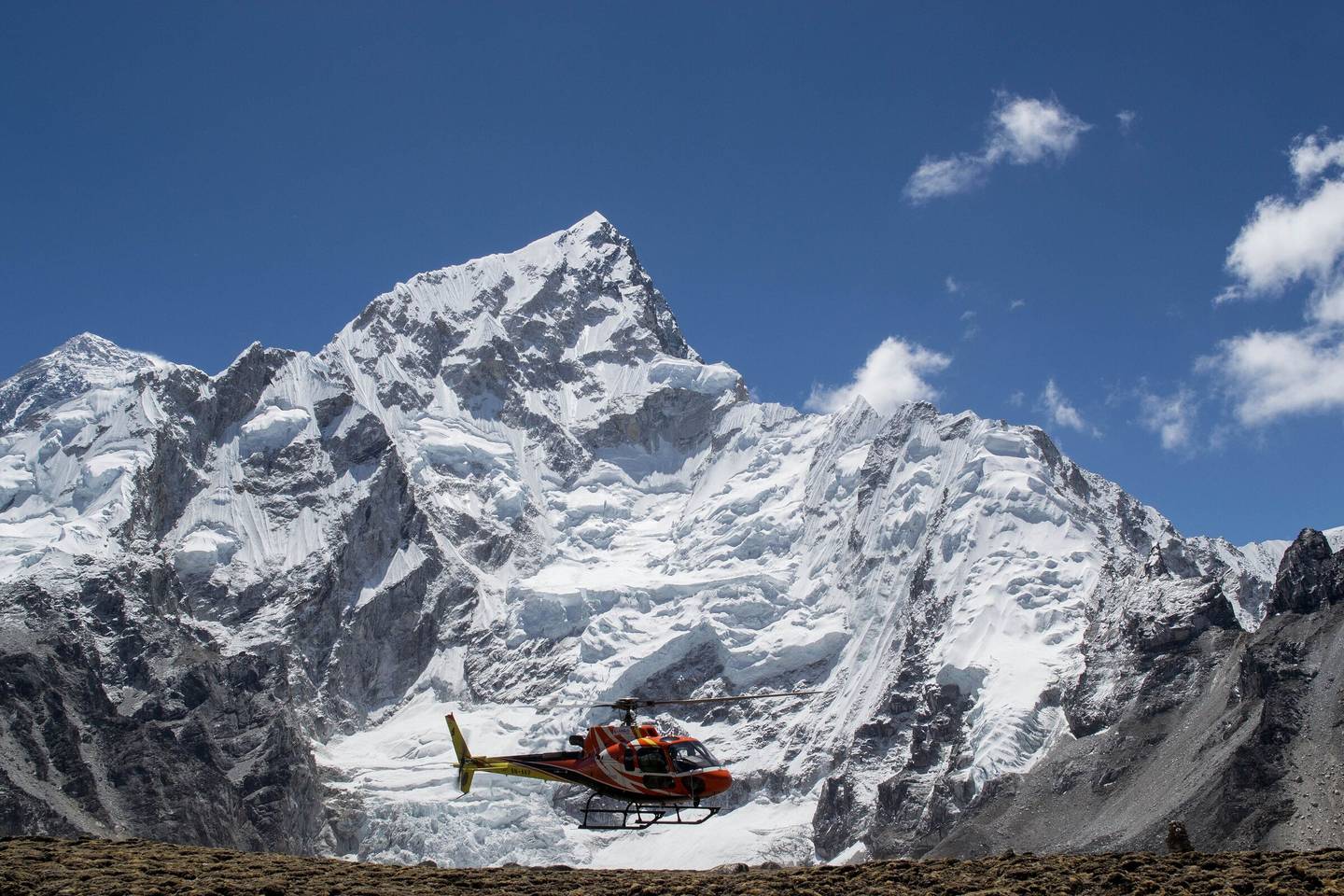
Search and rescue in Nepal is run by the Nepal Police, the Nepal Army and the Armed Police Force, with the Civil Aviation Authority of Nepal coordinating air searches. Nepal has no standing search-and-rescue unit, so a search for a missing trekker in the Khumbu or the Annapurna region is assembled from those agencies and chartered civil helicopters.
A search and a rescue are different operations. A rescue has a location and a patient; a search has neither, and that difference decides who is called first.
If somebody's position is known and they need to come off the hill, that is how a helicopter rescue is called rather than a search. This page is about the other case: a trekker who has not arrived, and nobody knows where they are.
Which organisations run search and rescue in Nepal?
The Nepal Police take the missing-person report. Jurisdiction sits with the district police office covering the place the person was last seen, which is why the first useful piece of information is a location rather than a name. The Tourist Police run a toll-free line, 1144, published on the Nepal Police website, and their central office is at Bhrikutimandap in Kathmandu, inside the Nepal Tourism Board premises.
The Nepal Army supplies the aircraft and most of the manpower. Its disaster role is primarily search and rescue, and it is the organisation that puts helicopters and soldiers over snow-covered ground.
The Armed Police Force holds a search-and-rescue mandate under the Armed Police Force Act 2058 (2001), and fields specialist teams including dog handlers and rope-rescue crews.
The Civil Aviation Authority of Nepal, CAAN, runs the formal end of the system. Its Civil Aviation Requirements for Search and Rescue, CAR-12, make CAAN responsible for a rescue coordination centre within the Kathmandu Flight Information Region, and Nepal's own Aeronautical Information Publication places that centre at Tribhuvan International Airport in Kathmandu. That system exists for aircraft, not for a trekker who did not reach a lodge.
The Himalayan Rescue Association is medical. The charity was founded in 1973 to reduce casualties in the Nepal Himalaya, and staffs seasonal aid posts at Manang, 3,500 m, and Pheriche, 4,200 m, with volunteer doctors. It treats and advises; it does not run searches, and a family calling it expecting one is losing hours.
The Trekking Agencies' Association of Nepal, TAAN, and the Nepal Tourism Board hold the registration data a search starts from, and both are standard points of contact for a family.
Go Heli Nepal is a marketplace. We book licensed operators. We do not fly, search or provide medical care, and nothing on this page should be read as an offer to.
| Organisation | Does | Does not |
|---|---|---|
| Nepal Police | Takes the report, holds jurisdiction | Fly aircraft |
| Nepal Army | Aircraft and ground manpower | Take the report |
| Armed Police Force | Dog and rope-rescue teams | Coordinate air searches |
| CAAN | Aeronautical rescue coordination | Search for a person on foot |
| Himalayan Rescue Association | Seasonal aid posts, medical care | Conduct searches |
| Your embassy | Contacts Nepali authorities | Investigate |
Roles as described by each body's own published material. A single operation usually involves several of them at once.
Does Nepal have a dedicated search and rescue service?
Nepal has no standing unit for mountain searches, and its own aviation publication says so plainly. The search and rescue section of the CAAN Aeronautical Information Publication states that specific SAR aircraft are not immediately available in Nepal, and lists elements of the Nepal Army, Nepal Police, Armed Police Force, local bodies and airline operators as available when required.
A 2022 paper in the Journal of APF Command and Staff College reached the same conclusion from the other direction, finding that specialised, integrated search and rescue teams have not been formed in Nepal and that each security agency keeps its specialist capability inside itself.
The practical consequence is that what reaches you is assembled rather than dispatched. Assembly takes authorisations, a tasking and an aircraft that was doing something else an hour ago, and all of it happens before anybody is looking at the ground.
How does a search for a missing trekker start?
Nothing starts it automatically. No agency tracks trekkers, no permit expiry raises an alarm, and a missed exit date is noticed by a person rather than by a system.
In practice the trigger is one of three people: the trekking agency whose client has not come out, a lodge owner expecting a booking, or family at home who have stopped hearing anything.
The report goes to the Nepal Police, at the district police office covering where the person was last seen, with the Tourist Police line, 1144, dialled in parallel. Give the full name, the last known location and the time of last contact in the first sentence. Those three facts are what the search is built from.
A foreign national's embassy is notified next, and it is worth knowing what that does and does not buy. Australia's Smartraveller service states that consular officials cannot actively investigate missing persons overseas, and that local investigation is a matter for the local authorities. An embassy opens doors to Nepali agencies. It does not search.
The insurer's assistance line belongs in the same hour. If a position is established later and somebody has to be lifted off the hill, you can send a rescue request from the trail or from home.
What does a search team actually have to work from?
A search works outward from the last place the missing person can be documented, not from the last place they were. Those are rarely the same point.
The documents are ordinary ones. A Trekkers' Information Management System registration, co-managed by the Nepal Tourism Board and TAAN, records identity, the planned route, an emergency contact and the expected entry and exit dates. National park and police check-posts log a passage. Lodge registers hold a night and a name. A guide carries the itinerary in their head.
What almost never helps is a phone. Mobile coverage fails across the high passes, and in the November 2026 search for six Indian trekkers near Shey Phoksundo, Nepali reporting named the absence of connectivity in the passes as a reason the missing could not be contacted at all.
Here is the rule of thumb worth carrying. The search area is set by the gap between the last confirmed sighting and the moment somebody reports it. A day's walking either side of a known trail junction is a valley a team can cover. Three days' walking is a district, and a district in Nepal is terrain rather than a square on a map.
That gap is the one part of the system a trekker controls.
How long do searches for missing trekkers usually last?
Days to weeks, and they are suspended rather than closed. Weather is what suspends them.
In January 2020, after four South Korean trekkers and three Nepali guides went missing in an avalanche in the Annapurna region, the search was suspended for weather and safety and then resumed once conditions improved. Reuters and the Indian daily Deccan Herald both reported that sequence. In September 2026 the search for twelve people missing near Himlung Himal was temporarily suspended for the same reason.
Suspension is not the end of it. In April 2017 a Taiwanese trekker, Liang Sheng-yueh, was found alive on a ledge after 47 days missing in Nepal. The Taipei Times and CBS News both reported that his companion had died three days before he was found, and that the search had been suspended and later resumed. He had been trekking without a local guide.
A family told that the search has stopped is usually being told about the weather.
Where does a search in the Khumbu or the Annapurna region begin?
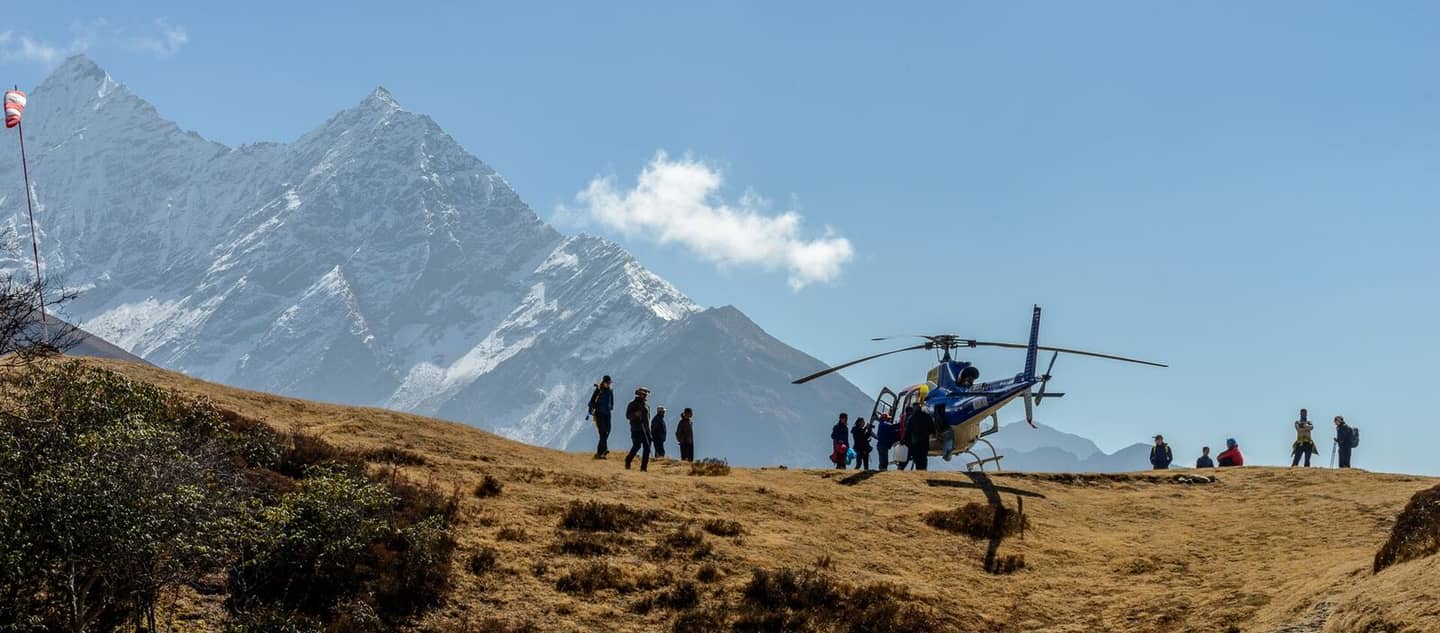
In the Khumbu, the practical starting point is Lukla. Tenzing–Hillary Airport sits at 2,845 m (9,334 ft) and is the gateway to every trail above it, so a Khumbu search is organised from the airfield and the villages on the way up: Namche Bazaar, Pheriche, and the upper valley beyond them.
In the Annapurna region, Pokhara is the equivalent, and the Manang trail carries the Himalayan Rescue Association's other aid post.
Both regions share a constraint that is easy to miss from a map. A search by air sees only what the cloud allows, and the flyable window in these valleys runs from first light until the cloud builds. A team that launches at nine in the morning may get two hours of useful searching, not eight.
Once a position is established and the problem becomes extraction rather than searching, helicopter rescue in Nepal is the separate operation that follows.
Why should you leave your route with someone before you trek?
Because your itinerary is the input to the search. If nobody holds it, the search starts from a permit instead.
What is worth leaving, with one named person who is not on the trek: the route, the dates, the villages you expect to sleep in, your guide's or agency's name and number, and the day you expect to be back in Kathmandu or Pokhara.
Then agree what happens if you miss a check-in. A day of silence in the high valleys is normal and means nothing. Three days of silence past an agreed date is the point at which somebody should be telephoning the Nepal Police, and the person at home needs to know that in advance rather than deciding it while frightened.
Questions this article answers
Which organisations run search and rescue in Nepal?
Search and rescue in Nepal is carried out by the Nepal Police, the Nepal Army and the Armed Police Force, with the Civil Aviation Authority of Nepal responsible for aeronautical rescue coordination within the Kathmandu Flight Information Region under its CAR-12 requirements. The Himalayan Rescue Association is a medical charity rather than a search body. Nepal has no single standing search and rescue unit, so each operation is assembled from those agencies.
How does a search for a missing trekker start?
A search for a missing trekker in Nepal starts when a person reports it, not automatically. The report goes to the Nepal Police at the district office covering the place the trekker was last seen, with the Tourist Police line 1144 called in parallel and a foreign national's embassy notified. Give the full name, the last known location and the time of last contact first, because those three facts define the ground a team has to cover.
How long do searches for missing trekkers usually last?
Searches for missing trekkers in Nepal usually run for days to weeks, and they are suspended for weather rather than formally closed. A suspended search often resumes once conditions improve. In April 2017 a Taiwanese trekker, Liang Sheng-yueh, was found alive after 47 days missing, following a search that had been suspended and then resumed, as the Taipei Times and CBS News both reported at the time.
Why should you leave your route with someone before you trek?
Leaving your route with a named person before trekking in Nepal matters because that itinerary is what a search team works from. A search is built outward from the last place a missing trekker can be documented, so the gap between a last confirmed sighting and the moment somebody reports it sets the size of the ground to be covered. Leave the route, the dates, the lodges, your guide's number and the day you expect to be back.