Aircraft registrations you will see on a Nepal helipad
Go Heli Nepal7 min read
Photograph: © John Pavelka / Wikimedia Commons · CC BY 2.0
Nepal's civil helicopters carry a 9N mark and the Army flies NA. What each prefix means, where to read it on an airframe, and what it does not prove.
An aircraft registration is the mark painted on an airframe that identifies its entry on a national register, and in Nepal it begins 9N. Every civil helicopter working out of Kathmandu carries one: Rotorspot's current civil rotorcraft register for Nepal lists 41 active 9N- entries. The Nepalese Army flies the same helipads under a separate NA- serial.
The marks are read on the ground, and in the Kathmandu Valley that ground moved recently. The Civil Aviation Authority of Nepal opened a dedicated heliport at Nalinchowk in Bhaktapur on 21 June 2024 to take helicopter traffic off Tribhuvan International Airport, and reporting at the opening put its capacity at 17 helicopters with room for four to land at once. That is the only apron in Nepal where a row of registrations can be read side by side. Which type wears which mark is a separate question, set out under helicopters used in nepal.
What does the 9N on a Nepali helicopter stand for?
It is Nepal's nationality mark, and it is a radio callsign block before it is anything else.
ICAO Annex 7 is the convention that governs this. A state selects its nationality mark from the radio callsign symbols allocated to it by the International Telecommunication Union, then notifies the selected mark to ICAO. Nepal's is 9N. That is why the mark on a Nepali airframe opens with a digit: it is a radio prefix doing a second job.
The rest is domestic. Chapter B.1 of the Civil Aviation Authority of Nepal's Nepalese Civil Airworthiness Requirements covers the registration of aircraft in Nepal, the allocation of nationality and registration marks, and the display of those marks on Nepalese registered aircraft. An aircraft registered under it has Nepalese nationality, and CAAN maintains the register it sits on.
The full mark is 9N, a hyphen and three letters. 9N-AJJ is an AS350 B2 that Kailash Helicopter Services began commercial operations with in April 2018. 9N-ALC is a Manang Air AS350. 9N-AMI is an Air Dynasty H125.
Where do you read the registration on a helicopter?
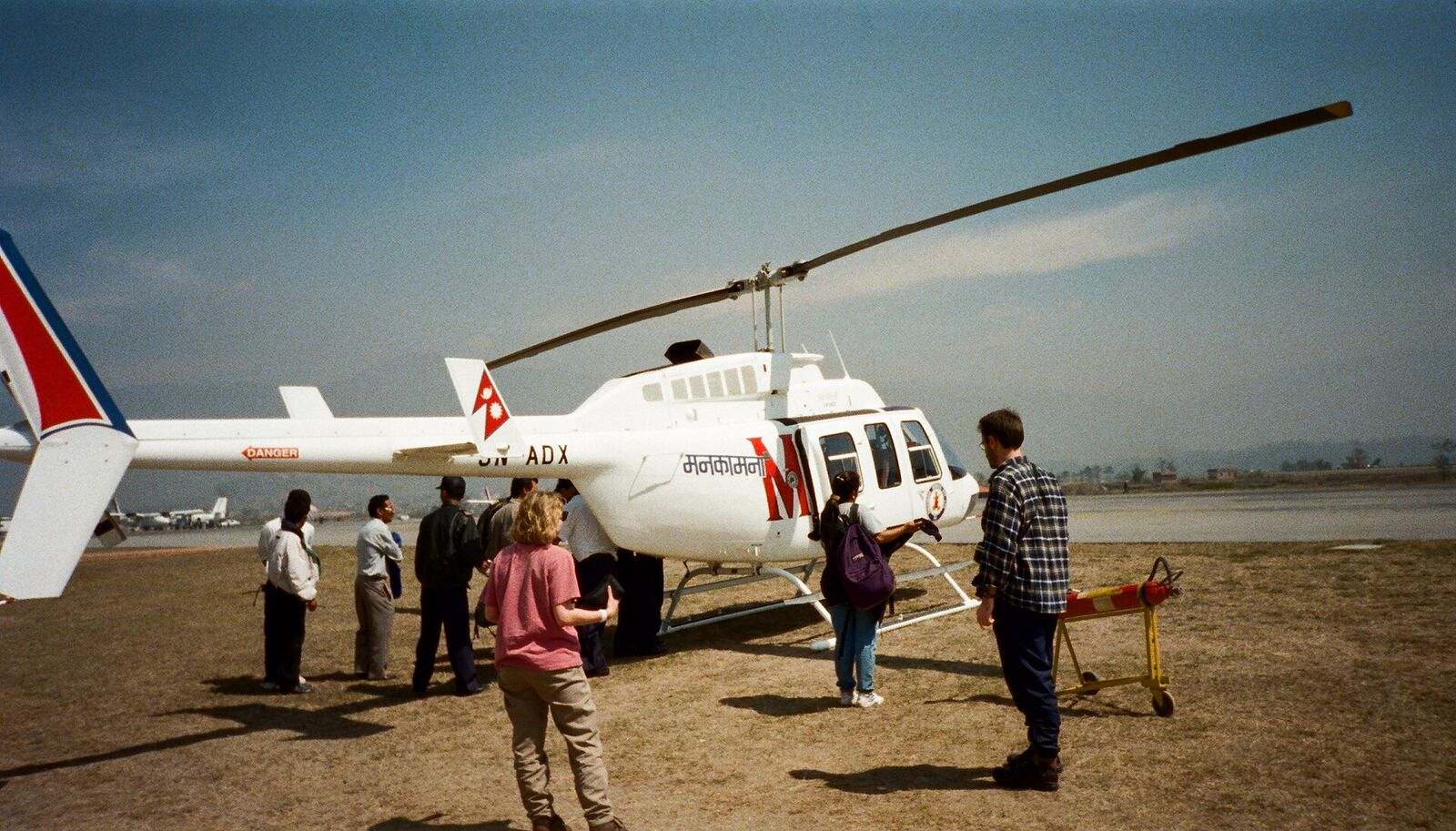
On the boom when it is parked, and on the belly when it is overhead.
ICAO Annex 7 requires a rotorcraft's marks to be displayed horizontally on both surfaces of the cabin, fuselage, boom or tail. It also requires them on the bottom surface of the fuselage or cabin, and sets their height there at 50 cm, or four fifths of the width of the fuselage or cabin, whichever is less.
The second placement is the one worth knowing, and it exists because a helicopter has no wing. On an aeroplane the registration is often large on a wing surface, and there is no equivalent panel on a single-rotor machine — so the convention puts the biggest set of characters underneath.
Which matches how a helicopter is actually seen. It is either parked, with the boom at eye level, or directly above you, where the only mark in view is the one on the underside. Seeing neither usually means you are standing on the wrong side of the aircraft rather than looking at an unmarked one.
Do the three letters after 9N tell you it is a helicopter?
No. Nepal reserves no letter block for rotorcraft, so the three letters identify one airframe and say nothing about what kind of airframe it is.
The register interleaves categories. Nepal Airlines' two Airbus A320s are 9N-AKW and 9N-AKX, delivered new in February and April 2015 according to published fleet records. The block immediately after holds helicopters: 9N-ALC with Manang Air and 9N-AMI with Air Dynasty. 9N-ANC was an ATR 72-500 turboprop. Four marks, three adjacent blocks, two categories of aircraft.
Some registers do encode the category. Published guides to the German register give D-H as the block for rotorcraft, which means a D-H mark is a helicopter before anybody looks it up. Nepal has no equivalent, so a 9N- mark cannot be decoded — only looked up.
That is not a defect in the system. It is the reason the mark is useful: a code that carried meaning would have to be reissued when the meaning changed, and this one never changes while the airframe is on the register.
| Mark | What it is | Operator |
|---|---|---|
| 9N-AKW | Airbus A320 | Nepal Airlines |
| 9N-AKX | Airbus A320 | Nepal Airlines |
| 9N-ALC | Airbus AS350 | Manang Air |
| 9N-AMI | Airbus H125 | Air Dynasty |
| 9N-ANC | ATR 72-500 | Yeti Airlines |
Types and operators as published fleet records, helis.com's 9N serial list and Rotorspot's civil rotorcraft register for Nepal give them. The letters run in sequence as airframes join the register, not by category.
Which registration prefixes appear on a Kathmandu helipad in Nepal?
Three, and only the first of them is on the civil register.
9N- is the commercial fleet. The Civil Aviation Authority of Nepal's Aviation Safety Report 2024 records 22 airline operators in operation in Nepal, 12 of them flying rotor-wing aircraft, and its operator list names Air Dynasty, Altitude Air, Annapurna Helicopters, Fishtail Air, Heli Everest, Kailash Helicopters, Manang Air, Mountain Helicopters, Mustang Helicopter, Prabhu Helicopters and Simrik Air. Every charter seat sold in Nepal is on one of these marks.
NA- is the Nepalese Army Air Service, in three digits rather than three letters. Helis.com's Nepalese Army database and Scramble's order of battle for Nepal both list the form: NA-029 and NA-030 on Alouette III airframes, NA-038 and NA-053 on Mil Mi-17s, NA-059 on an AW139. These aircraft share the aprons at Tribhuvan and the same mountain landing sites, and they are not on the civil register. Looking up an NA- mark in a civil database and finding nothing is the correct answer, not a gap.
A foreign mark is event-driven. The Center for Excellence in Disaster Management and Humanitarian Assistance's account of the 2015 earthquake response counts 23 foreign military helicopters deployed to Nepal — 13 from India, three from China and seven from the United States — operating through Tribhuvan International. Those carried military serials. Outside a surge of that kind, a foreign mark on a Kathmandu apron is unusual enough to be worth a second look.
And a mark is occasionally in transit. HeliHub reported the Nepalese Army's AW139 flying in army livery under the Italian test registration I-EASY, which is what a delivery looks like before the paperwork closes.
| Prefix | Register | When you see it |
|---|---|---|
| 9N- | Nepali civil | Every commercial charter |
| NA- plus three digits | Nepalese Army Air Service | The same aprons and sites |
| A foreign military serial | A visiting air arm | Relief deployments |
| A delivery or test mark | The exporting country | Briefly, before re-registration |
Operator counts are as the Civil Aviation Authority of Nepal's Aviation Safety Report 2024 gives them. Only the first row appears in a Nepali civil register lookup.
What does a 9N- mark actually prove?
That the airframe is on Nepal's register. Not that it may fly, and not who is flying it.
Registration and airworthiness are two certificates. Chapter B.1 of the Nepalese Civil Airworthiness Requirements covers the certificate of registration, issued by CAAN's Director General; Chapter B.2 covers the certificate of airworthiness. CAAN's requirements state that registering an aircraft does not permit it to fly without a valid airworthiness certificate. The painted mark is evidence of the first and silent about the second.
The mark is also silent about the operator. Nepal's civil airworthiness requirements have the certificate of registration carry the name of the owner and the name of the operator, and those can be different parties. An airframe leased between companies keeps its mark and changes its paint.
One thing it does prove. CAAN will not register an aircraft in Nepal if it is registered in any other country, so a 9N- mark means the airframe was struck off whatever register it came from first.
None of this is grounds for suspicion. It is the reason an operator's fleet page and the aircraft in front of you can both be accurate and still disagree.
How do you check the registration of your own flight?
Ask for it when you book, then read the boom before you get in.
The registration is the only identifier in the transaction that is unique, public and attached to the airframe rather than to the company selling you the seat. A type is not unique — several Nepali operators fly the same one. A livery is not attached to the airframe — it follows the lease.
If the mark on the boom is not the mark on the confirmation, the aircraft was substituted. That is ordinary rather than alarming: an airframe goes in for maintenance, a rescue takes priority, weather strands a machine up-country overnight. What a substitution can change is the type, and the type is what decides the elevation the aircraft can work at.
So the question worth asking is not whether the aircraft changed. It is what it changed to.
FAQs
What does 9N mean on a Nepali aircraft?
9N is Nepal's nationality mark, and every aircraft on the Nepali civil register carries it ahead of a hyphen and three letters — 9N-ALC, 9N-AMI. Under ICAO Annex 7 a state selects its nationality mark from the radio callsign symbols the International Telecommunication Union allocated to it and notifies that mark to ICAO, which is why Nepal's begins with a digit rather than a letter. The Civil Aviation Authority of Nepal allocates the three letters and maintains the register, under Chapter B.1 of its Nepalese Civil Airworthiness Requirements.
Where is the registration written on a helicopter?
On the sides of the cabin or tail boom, and on the underside of the fuselage. ICAO Annex 7 requires a rotorcraft's marks to appear horizontally on both surfaces of the cabin, fuselage, boom or tail, and also on the bottom surface, where it sets their height at 50 cm or four fifths of the width of the fuselage or cabin, whichever is less. A helicopter has no wing to carry a mark, so a parked machine is read on the boom and one passing overhead is read on its belly.
Do Nepalese Army helicopters carry a 9N registration?
No. The Nepalese Army Air Service uses NA- followed by three digits, and those aircraft are not on Nepal's civil register at all. Helis.com's Nepalese Army database and Scramble's order of battle for Nepal both list marks of that form, including NA-029 and NA-030 on Alouette III airframes and NA-038 and NA-053 on Mil Mi-17s. Army aircraft work the same aprons and the same mountain landing sites as the commercial fleet, so looking up an NA- mark in a civil register and finding nothing is the expected result rather than a missing record.
Can you tell from the registration whether a Nepali aircraft is a helicopter?
No, because Nepal reserves no letter block for rotorcraft. Nepal Airlines' two Airbus A320s are 9N-AKW and 9N-AKX, while 9N-ALC is a Manang Air AS350 and 9N-AMI an Air Dynasty H125, and 9N-ANC was an ATR 72-500 turboprop — adjacent blocks, two different categories of aircraft. Some registers do encode it: published guides to the German register give D-H as the block for rotorcraft, so a D-H mark is a helicopter before anybody looks it up. A 9N- mark has to be looked up.
Does a 9N registration mean a helicopter is airworthy?
No. Registration and airworthiness are two separate certificates in Nepal. Chapter B.1 of the Nepalese Civil Airworthiness Requirements covers the certificate of registration issued by the Civil Aviation Authority of Nepal's Director General, and Chapter B.2 covers the certificate of airworthiness; CAAN's own requirements state that registering an aircraft does not permit it to fly without a valid airworthiness certificate. A painted 9N- mark is evidence that the airframe is on the Nepali register and silent about everything else.
Ready to fly this route?
Compare every licensed operator that flies it, with seat and whole helicopter prices side by side.
See operators and pricesThe full answer, kept up to date: Flying from Kathmandu to Lukla