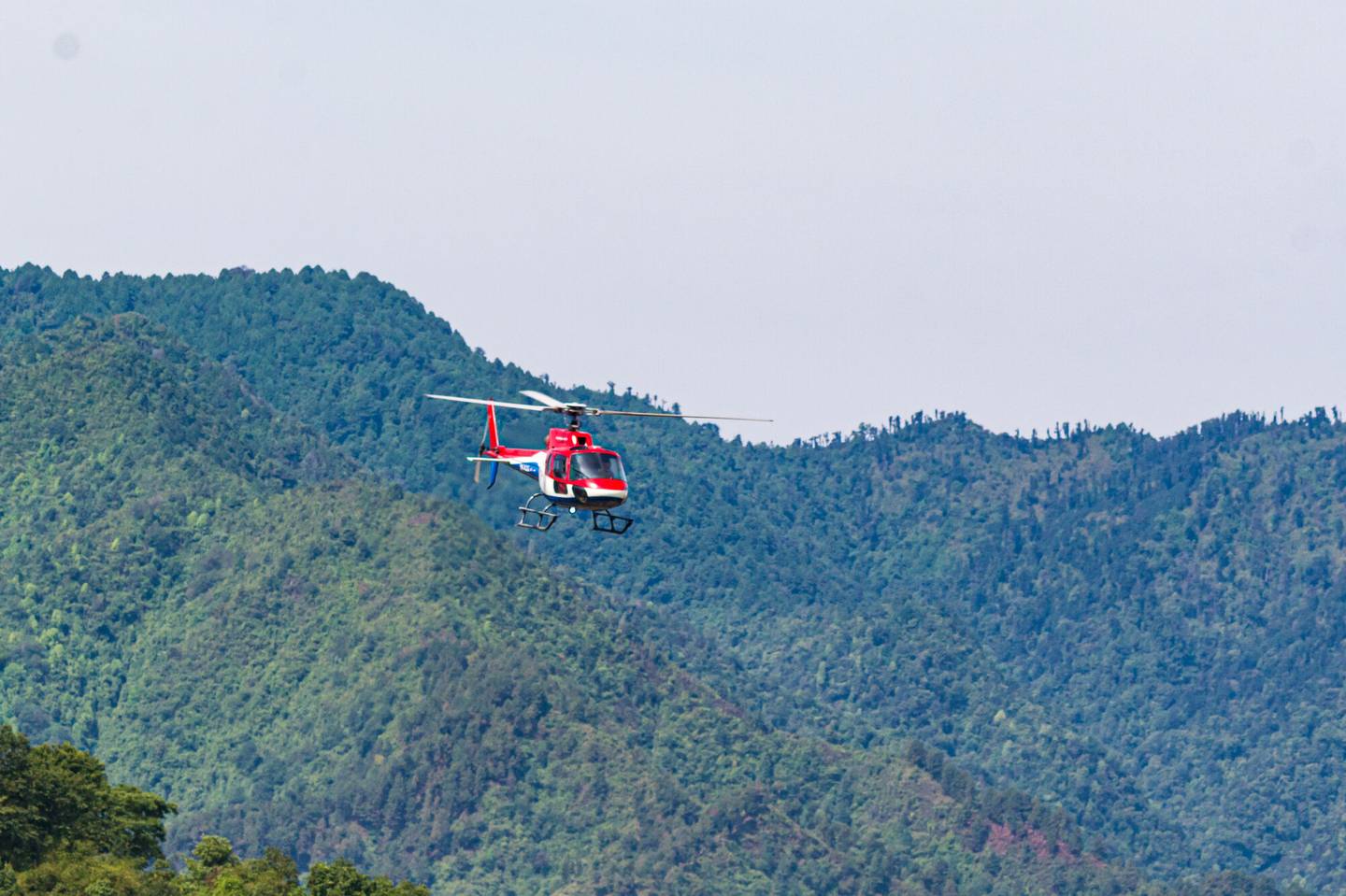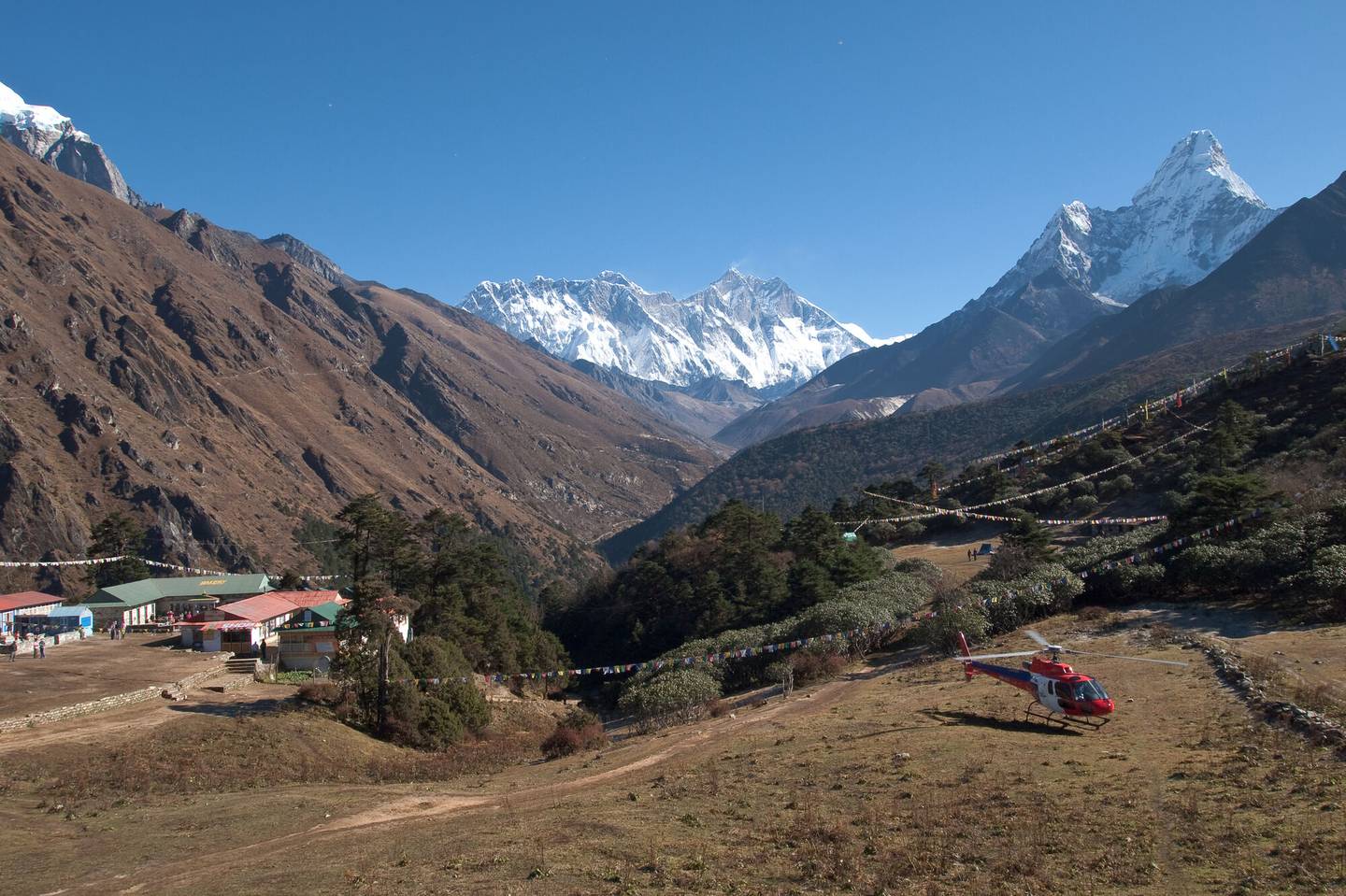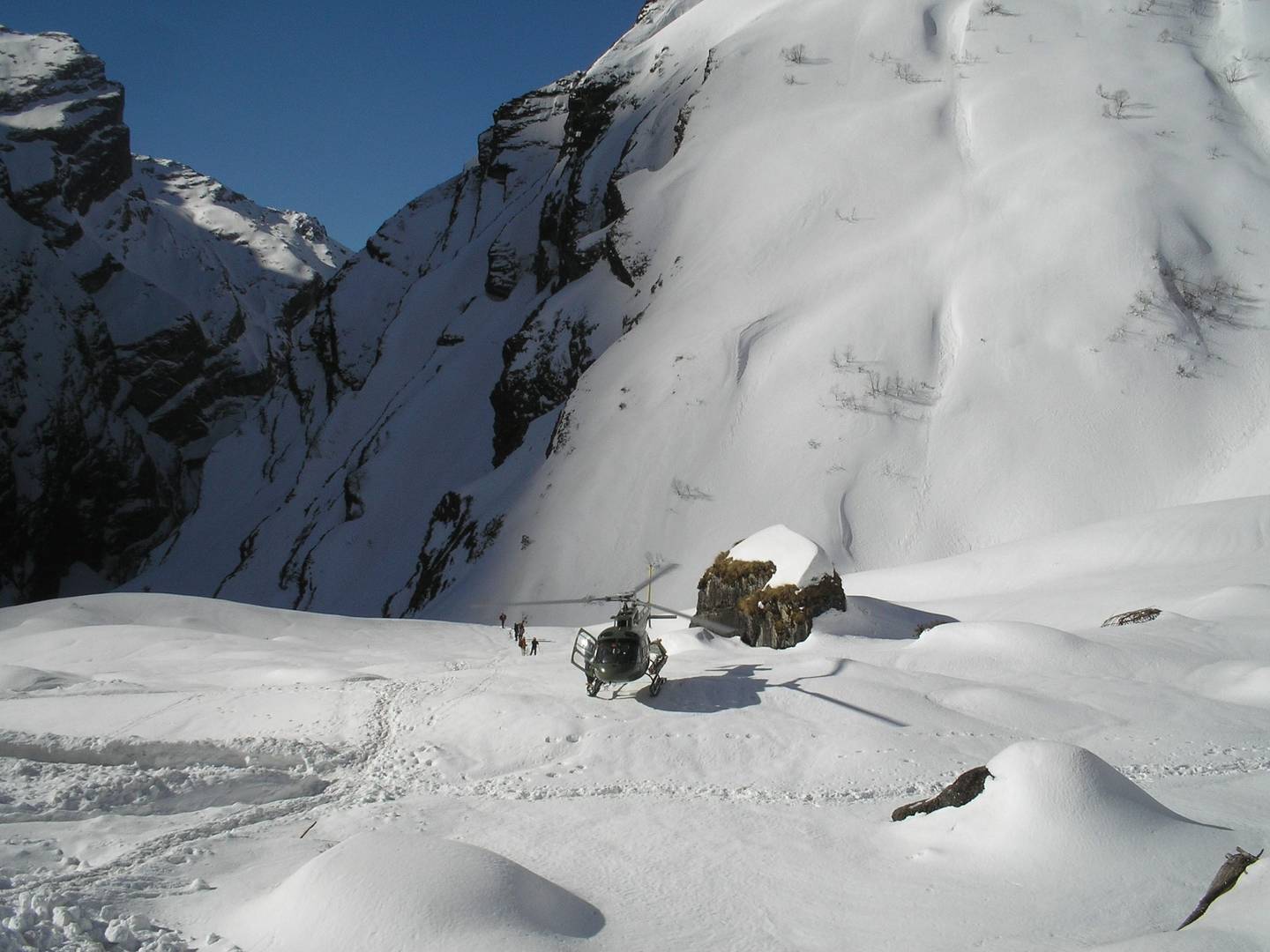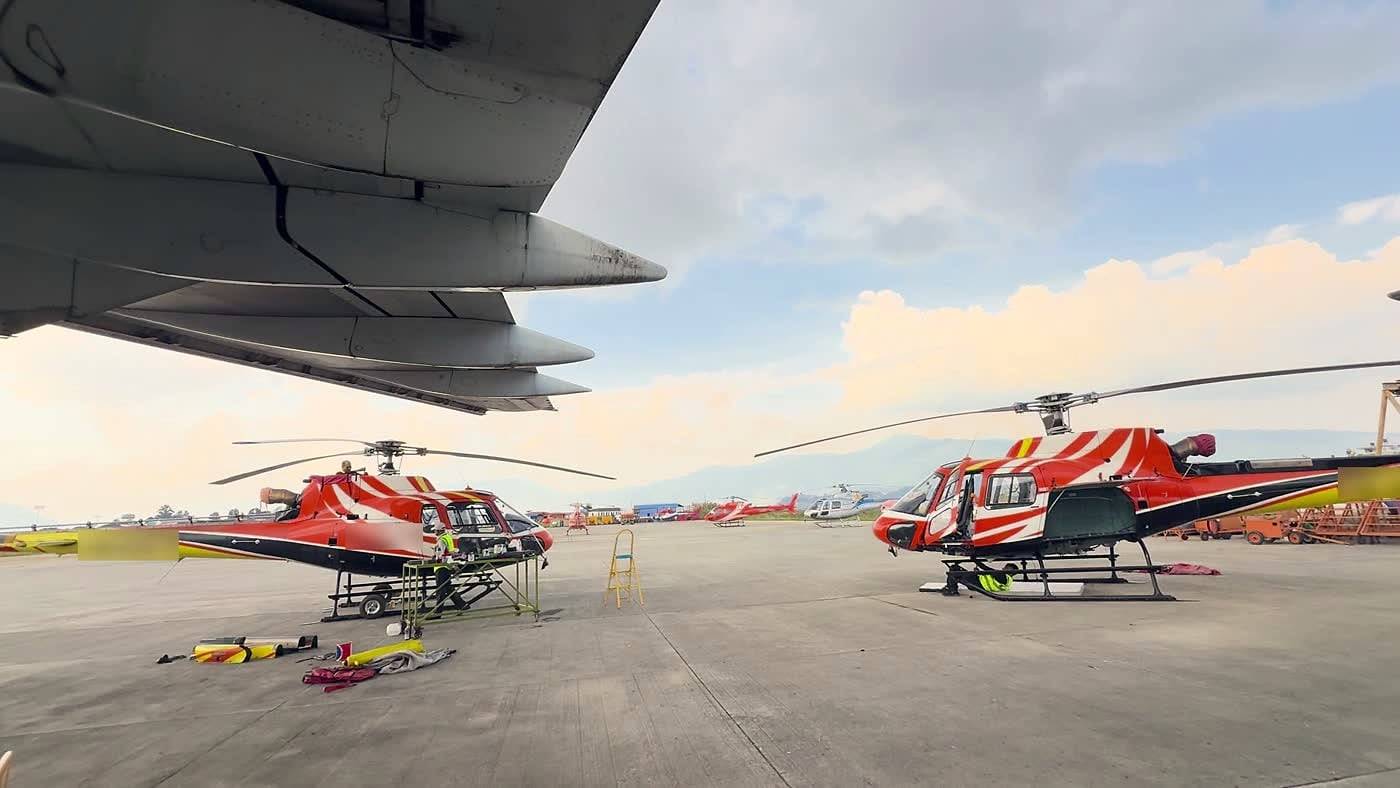

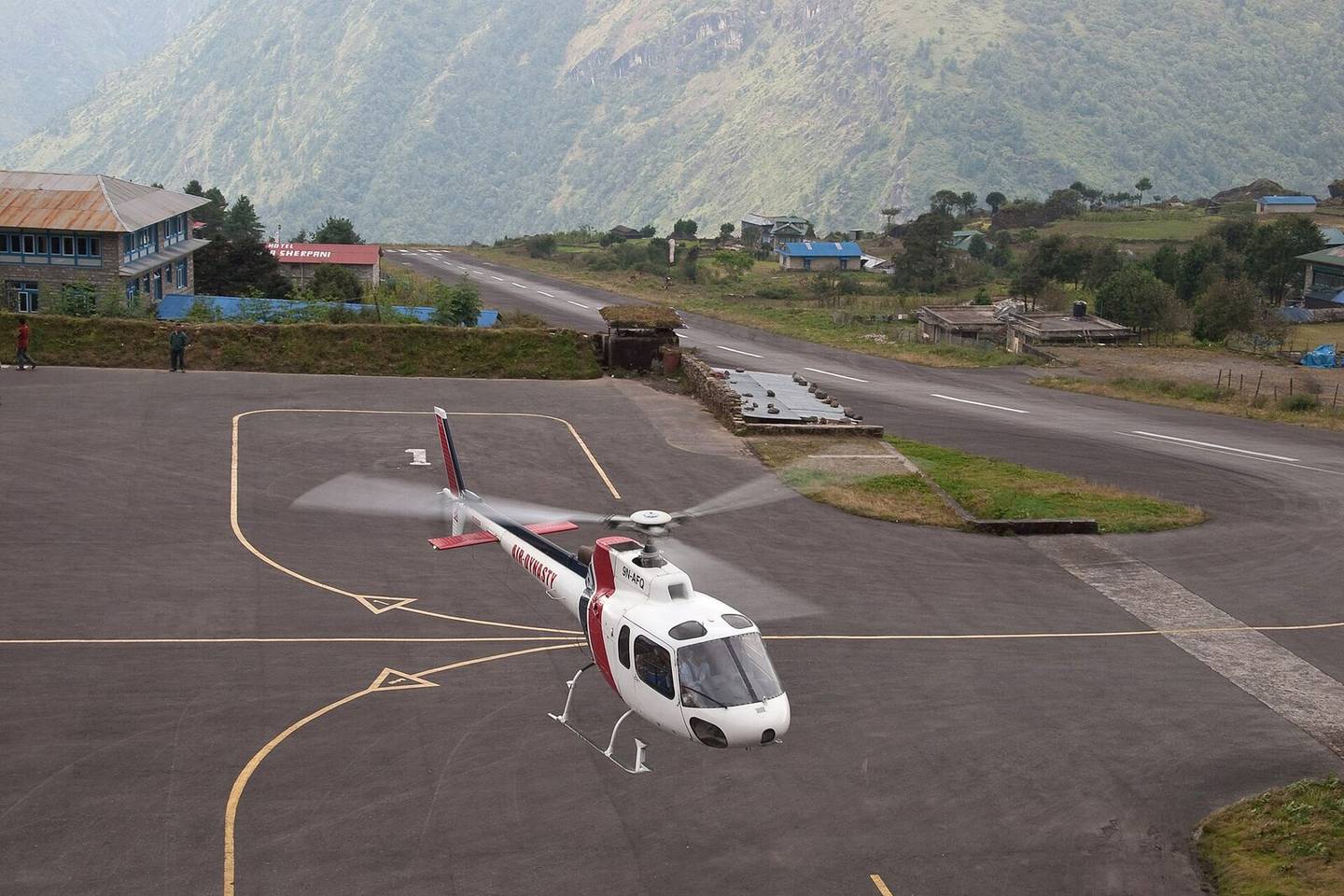
Six helicopter types do effectively all of Nepal's civil flying, from Kathmandu to the Khumbu: the Airbus AS350 B2, AS350 B3e and H125, the Airbus EC130, the Bell 407 and the Mil Mi-17, with a few lighter Bell and Robinson singles alongside. Five of the six are single-engine. What separates them is hover performance at weight rather than the service ceiling on the specification sheet.
The flying day starts at Kathmandu's Tribhuvan International, at 1,338 m, and most mountain work passes through Tenzing–Hillary Airport at Lukla, at 2,845 m, the nearest operating airport to Everest. The subject as a whole — helicopter capability, performance and aircraft in Nepal — has its own article. This one is the list, and what each type is used for. Buying or operating an aircraft is not covered.
What is the Airbus AS350 B3e, and why will you probably fly in one?
It is the single-engine Airbus that most Nepali operators fly, and it does the bulk of the country's mountain sightseeing, pilgrim and rescue work.
Go Heli Nepal publishes five seats, a ceiling of 23,000 ft and a cruise of 120 knots for the type. Published fleet listings put AS350 B3e aircraft with Basecamp Helicopters (formerly Manang Air), Altitude Air, Fishtail Air, Simrik Air and Shree Airlines, among others.
The letter at the end is the engine. Turbomeca's Arriel 2D, certified with a take-off rating of 950 shaft horsepower and a dual-channel digital engine control, went into service in the second half of 2011, and the B3e was launched around it at Heli-Expo that year. The B3 it replaced carried an Arriel 2B, which published type specifications rate at 847.
An AS350 B3 is the only helicopter to have landed on the summit of Everest, which it did twice, on 14 and 15 May 2005. That aircraft was stripped of seats and cargo and carried minimal fuel. It is not what the type does for a living, and it is not something a passenger can buy. What it does instead, and what each of its published figures is quoted against, is in the AS350 B3 on Everest work.
How is the Airbus H125 different from the AS350 B3e?
It is not a different aircraft. It is the same one under a newer name.
Airbus renamed most of its range at Heli-Expo in 2015, which Vertical Magazine reported at the time, and the AS350 B3e became the H125. The type certificate still calls both the AS 350 B3, and the older B2 keeps its own name.
That is why a Nepali operator's fleet page can list an AS350 B3e and an H125 side by side without contradicting itself. The two entries are the same type at different build dates, and Go Heli Nepal publishes the same five seats, 23,000 ft ceiling and 120-knot cruise for both.
Airbus gives the H125 a maximum flight altitude of 7,010 m and a hover ceiling out of ground effect of 3,840 m at maximum take-off weight, on its technical information page for the type. The second figure is the one that decides where the aircraft can pick you up.
Where does the older AS350 B2 still fly in Nepal?
Lower down, on the work that does not need the last of the engine's power.
The B2 is the same airframe with an earlier engine. Published type specifications give it a Turbomeca Arriel 1D1 of 732 shaft horsepower, against 847 for the B3's Arriel 2B and the 950 Turbomeca certified for the B3e's Arriel 2D. From the bottom of that ladder to the top is about 30 per cent more power on an airframe that barely changed.
The type is on the Nepali register. Kailash Helicopter Services announced the start of commercial operations with an AS350 B2 in April 2018, under an air operator certificate issued by the Civil Aviation Authority of Nepal.
Power is exactly what thin air takes away, so the B2 belongs on lower-elevation transfers and sightseeing and the B3 family goes up. That last step is inference from the engine ratings rather than a published operating rule — no operator publishes an elevation at which it swaps one variant for another — but it is the reason the variant letter is worth asking about.
Is the Airbus H130 an AS350 B4?
It is not. The EC130 is a wide-body derivative of the AS350, certificated on the same type certificate, not a fourth generation of it.
Anyone searching for a B4 helicopter is looking at this aircraft. The EASA type certificate data sheet lists it as a model of its own, the EC 130 B4, on the same type certificate as the AS350, and Airbus sells the later EC 130 T2 as the H130.
What it changed was the back and the sides rather than the power. The EC130 took a larger cabin and a Fenestron, Airbus's shrouded tail rotor, in place of the AS350's conventional tail rotor.
In Nepal it is rare. Mountain Helicopters of Kathmandu flew one EC130 B4, built in 2002, but we cannot confirm that one is in service today.
So the B-numbers are not a single ladder. B2, B3 and B3e are one airframe with progressively more engine. B4 is a different aircraft with a different tail, and a page that lists it as the newest AS350 has misread a type certificate.
| Designation | Engine or change | What it is |
|---|---|---|
| AS350 B2 | Arriel 1D1, 732 shp | The earlier single |
| AS350 B3 | Arriel 2B, 847 shp | The high-altitude single |
| AS350 B3e | Arriel 2D, 950 shp, digital control | The B3 with the newer engine |
| H125 | Arriel 2D; renamed in 2015 | The B3e under its current name |
| EC130 B4 | Fenestron, wider cabin | A derivative on the AS350 certificate; the later T2 is the H130 |
Engine ratings are as published type specifications and Turbomeca's own certification announcement give them. There is no AS350 B4: the B4 designation belongs to the EC130, a separate model on the same EASA type certificate.
What is the Bell 407 used for in Nepal?
Mid-altitude charter and longer sectors, on four rotor blades instead of three.
The Bell 407 is a single-engine derivative of the Bell 206L-4 LongRanger and entered service in 1996. Published specifications give it one pilot and six passenger seats.
Its ceiling is the point of difference. Type specification listings put the 407's service ceiling near 18,700 ft and quote up to 20,000 ft for later variants, so in every version it sits below the 23,000 ft the AS350 family carries.
It flies in Nepal on both registers. Simrik Air has listed a Bell 407 alongside its AS350 B3es, and the Nepalese Army is reported to fly the type as well.
The extra blade is not the reason it goes where it goes. A four-blade main rotor buys a smoother ride and a quieter cabin. What decides where an aircraft can work is power against weight, and above the middle altitudes the AS350 family has the better of that.
Does anyone fly the Bell 412 in Nepal?
Not a civil operator. The type turns up on lists of Nepal's helicopters because Bell demonstrated it here, not because a Nepali company flies one.
No Bell 412 appears on Nepal's civil helicopter register as of November 2026. The Nepalese Army has two Bell 412EPX on order under a United States grant, with delivery not expected before 2030, as the Kathmandu Post reported in August 2026.
The demonstration is real. Vertical Magazine reported Bell flying the 412EPI near Everest in June 2016, in an in-ground-effect hover at nearly 18,000 ft density altitude and in flight to 20,000 ft pressure altitude.
So the only twin-engine helicopter in Nepal's civil flying today is the Mil Mi-17, and a nine-seat twin is not something a traveller can book here.
Why does the Mil Mi-17 carry the most and land the lowest?
Because its lifting capacity is bought with weight, and weight is what thin air punishes hardest.
The Mi-17 is the heavy twin on Nepal's civil register. Shree Airlines lists six Mil Mi-17 alongside two AS350 B3e, though published fleet data notes that several of the Mi-17s have been based abroad.
Its two headline figures sit further apart than any other type here. Army Technology gives the Mi-8 and Mi-17 family a service ceiling of 6,000 m, and a hover ceiling out of ground effect of about 3,950 m for the versions with the uprated TV3-117 engines that Nepal flies, against 1,760 m for the older Mi-8MT. GlobalSecurity's entry on the uprated Mi-171, with TV3-117VMA engines, records take-offs and landings cleared up to 4,000 m and level flight to 6,000 m.
Read the pair rather than the first number. Even uprated, an aircraft that may be flown to 6,000 m but hovers out of ground effect at about 3,950 m at weight is a freight and relief machine, not a high mountain-landing one. The uprated engines moved the hover figure, because the hover figure was what was doing the limiting.
That is what the type is used for here: cargo, relief loads, and moving numbers of people between places with room to land.
Which of these types can work above Lukla, in Nepal's Khumbu?
Compare the type's hover ceiling with the landing elevation and ignore its service ceiling.
A service ceiling describes an aircraft in forward flight, where the rotor is being fed air by the machine's own speed. A landing needs a hover, and the hover figure is always lower — for the Mi-17 family, by about two kilometres even with the uprated engines. Every type on this page can be flown higher than it can land.
The general form of that argument is set out under how helicopters perform in nepal. Applied to a list of aircraft it collapses into one rule of thumb: if the itinerary lands above about 3,000 m, expect an AS350 or an H125, and if an Mi-17 appears in the plan then the job is weight or bulk at an elevation where the air still supports it.
Which is also how to read an operator's aircraft page. A type list is a list of jobs the company can do, not a list of aircraft that can all reach the same place.
| Type | Engines | What it is used for |
|---|---|---|
| Airbus AS350 B2 | One | Lower and middle elevations |
| Airbus AS350 B3e | One | Most of Nepal's mountain flying |
| Airbus H125 | One | The same aircraft, current build |
| Airbus EC130 B4 | One | A wider cabin; rare in Nepal |
| Bell 407 | One | Mid-altitude and longer sectors |
| Mil Mi-17 | Two | Freight and relief loads |
Roles follow the published ceilings and hover figures named above rather than an operator's price list.
Why does Nepal's helicopter fleet look like this?
Because the high-altitude helicopter was specified here before it was ever bought here.
Published type histories agree on the origin of the category. Aérospatiale built the SA 315B Lama to the hot-and-high requirement of the Nepalese Army Air Service and the Indian Air Force, and the type entered service in July 1971.
The recipe was the whole point. The Lama put the engine and the rotor system, transmission and gearboxes of the seven-seat Alouette III onto the lighter Alouette II airframe: the most power the design would take, on the least airframe that would hold it.
Fifty years on, that is still what an AS350 B3e is. It is why five of the seven types here are single-engine, and why a second engine in Nepal buys cabin size rather than height.
Lighter machines are on the register too. Operator fleet listings show a Bell 206 JetRanger with Fishtail Air and Robinson R66s with Prabhu Helicopter, both working well below the mountain sectors.
And fleets move. An aircraft sold, leased away or grounded changes an operator's fleet without changing its website, so the type you will actually fly is the one named on your confirmation rather than the one on a page like this. Ask which type is allocated, and at what elevation it is expected to land. The mark painted on the airframe is the one identifier unique to it, and aircraft registrations you will see on a nepal helipad is how to read it.
Questions this article answers
Which helicopter is used most in Nepal?
The single-engine Airbus AS350 B3e and the H125 that replaced it in production do most of Nepal's helicopter flying, and published fleet listings show the type with Basecamp Helicopters (formerly Manang Air), Altitude Air, Fishtail Air, Simrik Air and Shree Airlines among others. Go Heli Nepal publishes five seats, a ceiling of 23,000 ft and a cruise of 120 knots for it. Airbus gives the H125 a maximum flight altitude of 7,010 m and a hover ceiling out of ground effect of 3,840 m at maximum take-off weight on its technical information page for the type.
What is the difference between an AS350 B2 and an AS350 B3?
The difference between an AS350 B2 and an AS350 B3 is the engine, and almost nothing else. Published type specifications give the AS350 B2 a Turbomeca Arriel 1D1 rated at 732 shaft horsepower and the AS350 B3 an Arriel 2B rated at 847, about 16 per cent more. The later B3e carries Turbomeca's Arriel 2D, certified with a take-off rating of 950 shaft horsepower and a dual-channel digital engine control. Thin air takes power away, so the gap between the variants matters most at the highest landing sites and hardly at all in a valley.
Is the EC130 B4 the same aircraft as an AS350 B4?
There is no AS350 B4. The EC130 B4 is certificated as a model of its own on the same type certificate as the AS350, which is why a search for a B4 helicopter lands on it, and Airbus sells the later EC 130 T2 as the H130. It is not a later generation of the AS350 B3. It is a derivative with a wider cabin and a Fenestron shrouded tail rotor in place of a conventional tail rotor. Mountain Helicopters of Kathmandu flew one EC130 B4, built in 2002; we cannot confirm one is in service in Nepal today.
Which helicopters used in Nepal have two engines?
The Mil Mi-17 is the only twin-engine type in Nepali civil service, flown for freight, relief loads and moving groups between places with room to land rather than for high landings. Shree Airlines lists six alongside two AS350 B3e, though several of the Mi-17s have been based abroad. No civil operator flies the Bell 412; the Nepalese Army has two on order. Every other type in regular civil use in Nepal has one engine: the AS350 B2, the AS350 B3e, the H125, the EC130 and the Bell 407.
Which helicopter types in Nepal can hover out of ground effect at Lukla?
All of the types in regular civil use can, in standard air at the weights their specifications are quoted at. Tenzing-Hillary Airport at Lukla stands at 2,845 m. Airbus gives the single-engine H125 a hover ceiling out of ground effect of 3,840 m at maximum take-off weight, which clears Lukla with margin. Army Technology gives the Mi-17 versions with uprated TV3-117 engines about 3,950 m, against 1,760 m for the older Mi-8MT, and GlobalSecurity records the Mi-171 as cleared for take-offs and landings up to 4,000 m. A hot afternoon or a heavy load can still take either below Lukla's height.